
Diamonds and gemstones
Lab-grown diamond jewelry wholesale: a retailer's checklist
By Siona Jewels team · · 9 min read
Short answer
Buy lab-grown diamond jewellery wholesale against a written checklist: a report whose number matches the girdle inscription, the right metal stamp or hallmark, colour-sorted melee, secure settings and a repricing clause. Prices fell sharply after 2022, and India's lab-grown exports dropped 10.55% in value in FY2025-26 while carat volumes rose.
A lab-grown diamond order rarely goes wrong at the stone. It goes wrong around it. The report number doesn't match the girdle, or the tag uses wording your market doesn't accept. Three stones in a pavé band look a shade warmer than the rest. A price agreed in spring looks expensive by autumn.
This checklist is for retail buyers, store owners and brand founders who buy finished lab-grown jewellery (rings, earrings, bracelets and pendants) from a manufacturer rather than loose stones. It covers why the trade runs through India and what the price fall since 2022 means for stock. It then works through CVD and HPHT, IGI and GIA reports, disclosure wording, and the checks to write into a purchase order. Whether to stock lab-grown at all is a separate decision, covered in lab-grown vs natural: what retailers should stock.
Why do retailers buy lab-grown diamond jewellery wholesale from India?
Because that is where the stones are cut. GJEPC figures put India's polished lab-grown diamond exports at US$1.13 billion (₹10,012.97 crore) in FY2025-26. A 2024 AFP report found that Surat cuts about 90% of all diamonds. Setting stones close to where they're cut keeps the supply chain short.
The headline value hides a split. GJEPC reported that lab-grown export value fell 10.55% on the year even as volumes rose. GJEPC's provisional figures for FY2025-26 put lab-grown polished exports at about 18.84 million carats, up 31%, against 16.00 million carats of natural, down 4%. India now ships more lab-grown carats than natural ones, at about US$60 a carat against about US$760 for natural. The lab-grown average checks out: US$1.13 billion ÷ 18.84 million carats ≈ US$60.
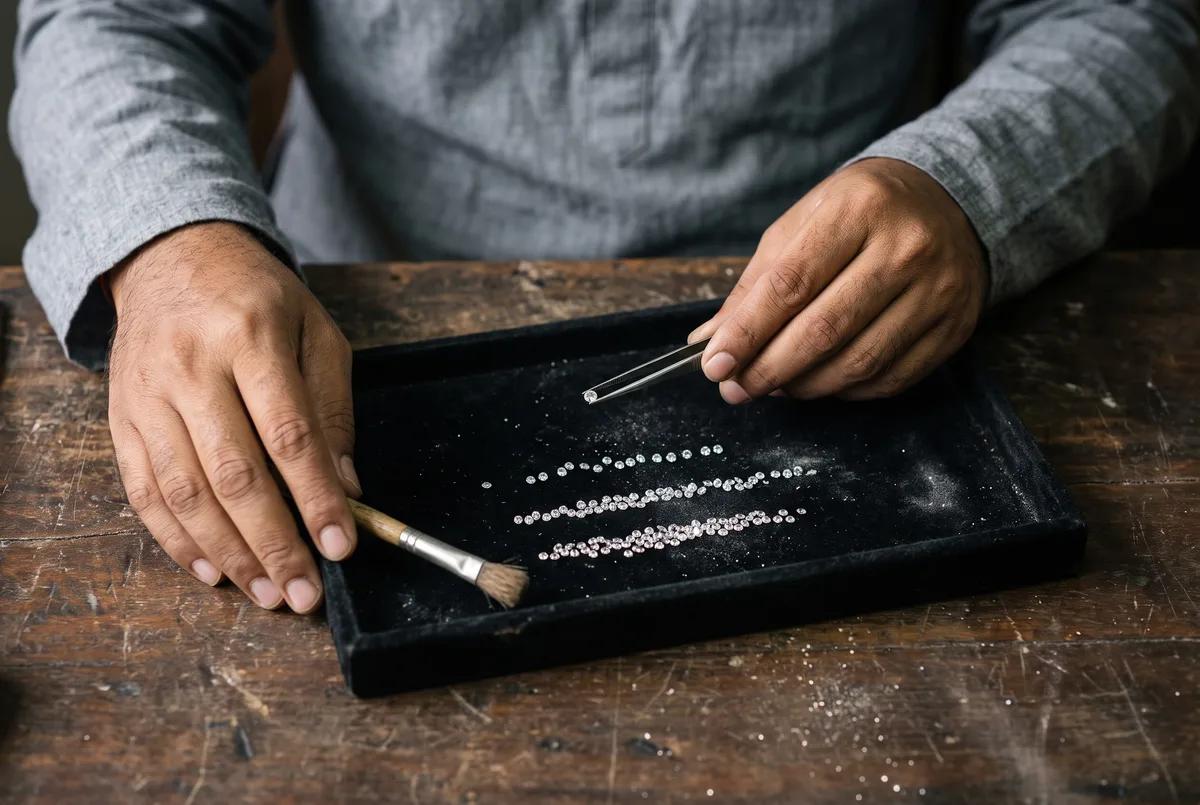
Small stones pull that average down, so it tells you nothing about the price of a 1 ct centre. It does show where the volume sits. Melee and small sizes go into pavé, eternity bands, tennis bracelets and studs, which is much of the finished stock retailers buy.
The value decline has since turned. GJEPC's September 2026 report puts lab-grown polished exports for April–September 2026 at US$685.1 million, up 17.1%. September alone was US$151.4 million, up 40.7%. For a buyer, that means deep supply and plenty of manufacturers to choose between. If India is new to you, start with how to source private-label jewellery from India.
How much have lab-grown diamond prices fallen since 2022?
Some stones lost more than half their value. The AFP report found a lower-quality 1 ct lab-grown diamond that cost about $2,400 in 2022 sold for just over $1,000 in 2023. It cited Edahn Golan's estimate of a 58% fall in wholesale lab-grown prices in 2023. By Q1 2025, Paul Zimnisky put a 1 ct lab-grown stone at about $845, CNBC reported.
These figures come from different sources measuring different stones, so don't join them into one curve. They point the same way as the export data, though. GJEPC's own figures put the average lab-grown export price at US$60.14 a carat in FY2025-26, down from about US$87.80 the year before: roughly 31% lower. Part of that is a shift towards smaller stones. Read it as a direction, not a price list.
What the price fall means for your stock
The stone is the part of a lab-grown piece most likely to lose replacement value while it sits in your case. Take the AFP figures. Twenty 1 ct solitaires bought in 2022 tied up about $48,000 in centre stones (20 × $2,400). A year later, the same 20 stones cost a little over $20,000. A shop that bought deep in 2022 was competing with shops that restocked for less than half the stone cost.
Three habits follow:
- Buy shallower and reorder more often. Hold core sizes and reorder against sell-through instead of taking a season's depth upfront.
- Split the invoice. Ask for metal, making and stone shown separately, so you can see which part is depreciating. Gold prices move both ways; lab-grown stone prices have mostly moved one way since 2022.
- Price on replacement cost. If your shelf price is set from what you paid, a competitor who bought later can undercut you without trying.
Is demand for lab-grown jewellery strong enough to stock it?
In US bridal, yes. The Knot's 2026 Real Weddings Study, based on 10,474 couples who married in 2025, found lab-grown centre stones in 61% of engagement rings. That's up from 52% a year earlier and up 239% since 2020. Couples who chose lab-grown spent about $4,300 on average for a 2.0 ct centre, IDEX reported, against $7,000 and 1.6 ct for natural.
The price gap explains much of that size. Zimnisky's Q1 2025 figures put a 1 ct natural diamond at about $3,895 against about $845 for lab-grown, roughly 4.6 times as much ($3,895 ÷ $845 ≈ 4.6). A customer with a fixed budget can buy a much larger lab-grown stone, and the survey suggests many do.
For a wholesale buyer, that shifts where the risk sits. A bigger centre puts more of each ring's value in one stone, so the report, the inscription and the setting that holds it all matter more. The study covers US engagement rings only. For fashion lines and other markets, test a small range before committing depth.
Does it matter whether a lab-grown diamond is CVD or HPHT?
Less than its grade and any treatment. Both methods produce real diamond, and a well-grown stone from either can grade the same. What matters is knowing. IGI's lab-grown diamond reports state the growth method (CVD or HPHT) in the comments, along with whether there's any indication of post-growth treatment, so check that line before you buy.
CVD (chemical vapour deposition) grows diamond layer by layer on a thin diamond seed plate inside a chamber of carbon-bearing gas. HPHT (high pressure, high temperature) grows it in a press that recreates the heat and pressure under which natural diamond forms. Some stones from either route are treated after growth to improve colour. Neither method is a quality grade in itself.
The method matters most in matched goods. For a pair of studs, a halo or a line bracelet, ask that the stones in one piece come from the same parcel. Stones that grade alike on paper can still look slightly different side by side. And if any stone has been treated, your description should say so. That means your supplier has to tell you first.
Should lab-grown centre stones carry IGI or GIA reports?
For centre stones priced on colour and clarity, IGI's full grading report gives the detail buyers shop on. Since 1 October 2025, GIA no longer grades lab-grown diamonds on the 4Cs. Its Laboratory-Grown Diamond Quality Assessment sorts D–J stones of 0.15 ct and above into Premium or Standard, at $15 per carat with a $15 minimum.
| IGI lab-grown report | GIA quality assessment |
|---|---|---|
What it tells you | Full grading, including colour and clarity grades | Premium or Standard, not individual grades |
Stones covered | Lab-grown diamonds | D–J colour, 0.15 ct and above |
Girdle inscription | "LABGROWN IGI" or "LG" with the report number | "Laboratory-Grown" plus the report number |
Fee | Check IGI's current schedule | $15 per carat, $15 minimum (as of October 2026) |
GIA's Premium tier requires D colour, VVS clarity or better, Excellent polish and symmetry, and an Excellent cut grade for rounds. Standard needs at least VS clarity, J colour or better, and Very Good polish and symmetry (Good symmetry for fancy shapes), plus a Very Good cut grade for rounds. Stones that miss Standard get no assessment and a US$5 fee. GIA has said that more than 95% of lab-grown diamonds entering the market fall within a very narrow range of colour and clarity. In practice, an E VVS2 and a G VS1 can both read "Standard" on a GIA assessment. On an IGI report they're two different stones at two different prices.
The GIA fee is easy to budget. A 2 ct centre costs $30 to assess (2 × $15). Fifty 0.25 ct stones for a stud line cost $750, because each one falls under the minimum (0.25 × $15 = $3.75, so $15 applies; 50 × $15 = $750). Fees change, so check the current schedule before you quote. For a fuller comparison that includes SGL, see IGI vs GIA vs SGL reports.
What wording must you use to describe lab-grown diamonds?
In the US, the FTC Jewelry Guides accept "laboratory-grown", "laboratory-created", "[manufacturer name]-created" or a term of like meaning, placed immediately before the word "diamond" and with equal conspicuousness. In India, the voluntary standard IS 19469:2025, reported by IDEX, permits "laboratory-grown diamond" and "laboratory-created diamond" for commercial use, and limits "synthetic diamond" to trade and import–export documents where the law requires it. It bars shorter forms such as "lab grown" and "LGD".
The FTC Guides were revised in July 2018. The principle is that the qualifier travels with the word. "Laboratory-grown diamond" on the front of a tag works. "Diamond" on the front with "lab-grown" in small print on the back is unlikely to pass the clear-and-conspicuous test.
IS 19469 also bars "lab-created", "man-made" and "cultured". It took effect on 1 January 2026 and is voluntary, but following it costs nothing and saves relabelling later. India-facing tags, invoices and product copy should therefore say "laboratory-grown diamond", even though trade shorthand, including this article, uses "lab-grown".
This guide doesn't cover Canadian or UAE rules in detail, so check those with your compliance adviser. "Laboratory-grown diamond" is a sensible default for shared tags because it appears on both the FTC and the BIS lists. Agree the exact wording with your manufacturer before production. It ends up on tags, invoices and packaging inserts, and changing it after printing costs time.
What should you check in a lab-grown diamond jewellery order?
Check that each report matches its stone's inscription, the metal carries the right stamp or hallmark, melee is sorted for colour and size, settings are secure, and the disclosure wording is approved. Then get return, replacement and repricing terms in writing. With some stones losing more than half their value between 2022 and 2023 on the AFP figures, that last check protects your margin.
Check | Why it matters | What to ask for |
|---|---|---|
Report number matches the girdle inscription | A mismatch means the wrong stone or the wrong paper | Report copies before dispatch; spot-check inscriptions under a loupe on arrival and verify numbers on the lab's website |
Growth method and treatment | You can't describe a treated stone correctly if nobody told you | The IGI comments line on growth method and post-growth treatment |
Metal stamp or hallmark | US pieces need a quality mark with a trademark; Indian gold needs a BIS hallmark | Stamp spec in the PO (karat plus whose trademark); BIS hallmark with HUID for India stock |
Melee colour and size sorting | One warmer or smaller stone shows in a pavé band or tennis line | An agreed colour range and size tolerance, set against an approved sample |
Setting quality | Lost stones come back to you as returns | Loupe check of every prong tip and seat; photos of finished pieces before dispatch |
Disclosure wording | FTC and IS 19469 terms differ from trade shorthand | Approved tag, invoice and insert wording for each market |
Returns and replacement | Defects found after delivery need a clear route | A written window, who pays freight, and replacement or credit |
Repricing on reorders | Lab-grown stone prices have fallen sharply since 2022 | A price reference date and a price review on each reorder |
Report and inscription
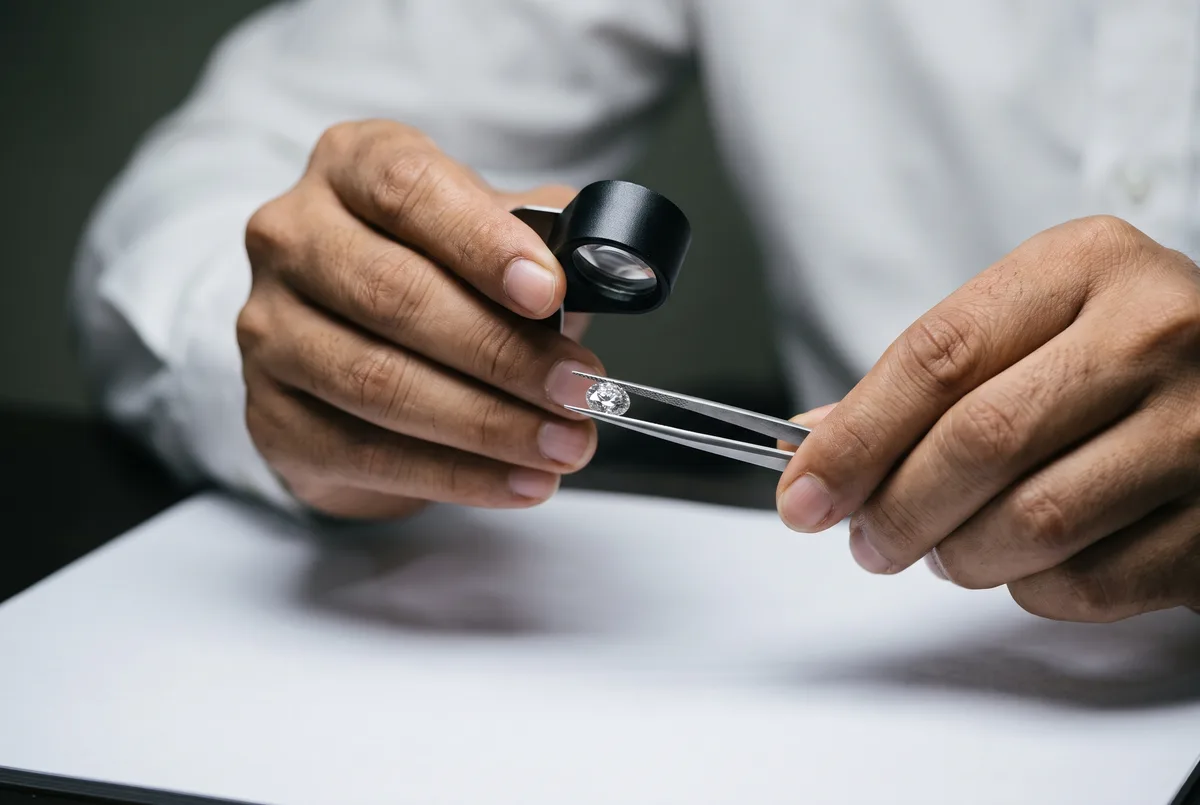
Ask for report copies before goods ship, not in the parcel. On arrival, check a sample of centre stones under a loupe: the inscription should carry the same number as the report. The inscription is the only link between the paper and the stone. Without that check, a report is just a document that travelled with the parcel.
Metal stamp and hallmark
For the US, a quality mark such as "14K" must be accompanied by a trademark or name, and you need to decide whose mark goes on the piece. For India, gold sold in BIS-notified districts needs a BIS hallmark with its HUID. Both are covered stage by stage in how jewellery is made, from CAD to hallmark.
Melee and settings
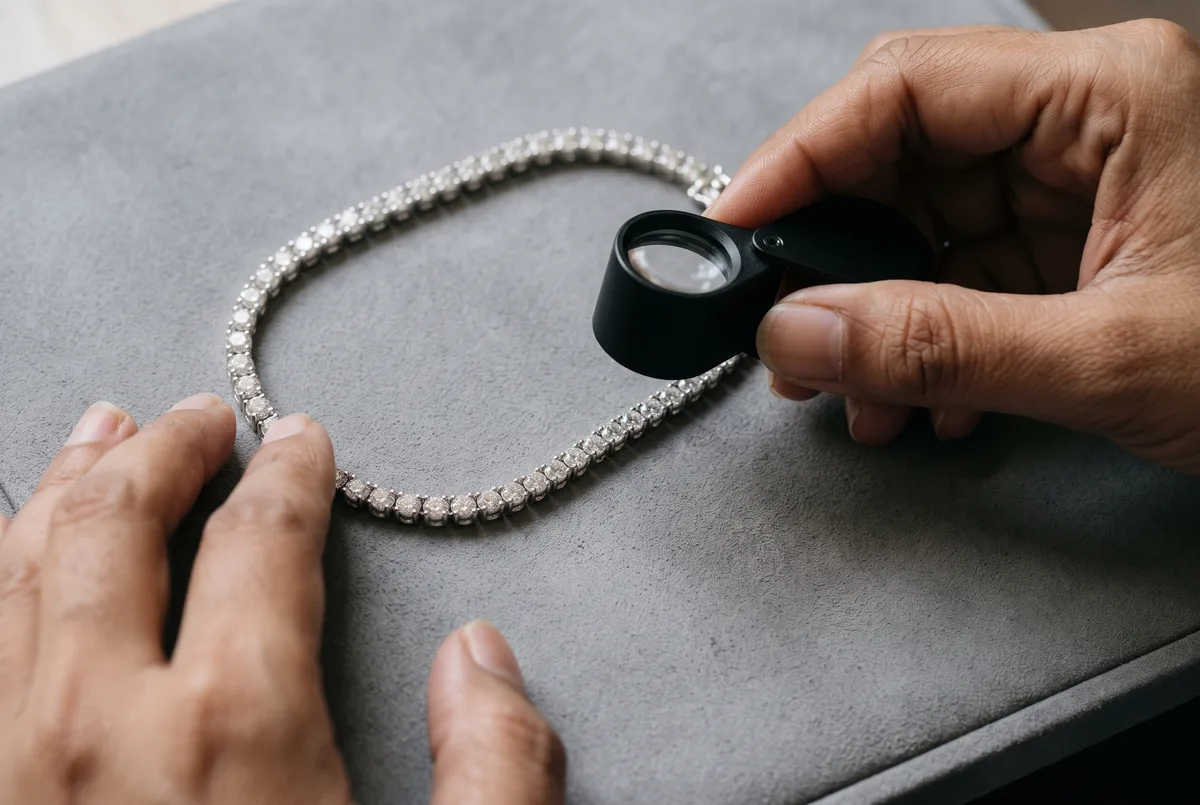
Ask how melee is sorted for colour and size before setting, and approve one sample per design as the reference. In a tennis bracelet, check link by link: stones level, colour even, no gaps. Prong tips should cover the girdle without snagging. Bezels should sit tight with no light gap, and channel walls should run straight.
Returns, replacement and repricing
Put the return window, the condition of returned goods, and who pays freight and duty into the contract. For stones, specify that a replacement must carry the same grade on the same type of report. For repricing, agree the reference date for stone prices and a review at every reorder. For illustration, if stones make up 40% of a piece's cost and stone prices fall 20% before your reorder, the piece should cost about 8% less (0.40 × 20% = 8%), all else equal. If you import into the US, land your costs with duty included; see US import duty on jewellery from India.
What to do next
Put the checklist in the purchase order, not in an email thread. Approve one sample per design, with its report, stamp and tag wording, and keep it as the master that production is checked against. Settle reorder pricing before the first shipment leaves. At Siona Jewels, typical production runs 2–6 weeks, so plan reorders around that window. When you have designs, metal, stone specifications and quantities, send a brief and compare quotes like for like.
Planning a range?
Send us your designs, metals and quantities, and we’ll reply with a quote and timeline within one business day.
Questions buyers ask
Usually not. GIA's lab-grown assessment covers stones of 0.15 ct and above, so the melee in most pavé bands and tennis bracelets falls below it. Ask instead for a written description of each parcel's colour range, clarity range and size. Then check finished pieces against the approved sample you signed off.
Yes. It's the same carbon crystal as a mined diamond, with the same hardness and optical properties; only the origin differs. That's why the FTC asks for an origin qualifier such as "laboratory-grown" beside the word "diamond". A simulant is different: it only looks like diamond, and can't be called a diamond unless "imitation" or "simulated" comes immediately before the word.
Ask for natural centre stones to carry a report from a recognised lab, and check the inscription against the report on arrival. For melee, get written confirmation that parcels have been screened. Keep natural and lab-grown lines on separate purchase orders so the two never share a parcel or a setter's tray.
It can, but the description must make each stone's origin clear. A natural centre with lab-grown side stones shouldn't be sold simply as a "diamond ring". Spell out the mix on the purchase order, the invoice and the tag, so nobody between the workshop and the customer has to guess which stones are which.
At least at every reorder, and whenever your supplier's quote for the same specification changes. Price on what it would cost to replace the piece today, not on what you paid. Because lab-grown stone prices have mostly fallen since 2022, pricing on cost paid tends to leave older stock above the market.