
Lab-grown vs natural diamonds: what should retailers stock?
By Siona Jewels team · Updated
Short answer
Lab-grown and natural diamonds are the same mineral, but their prices have split. In Q1 2025 a 1 ct lab-grown stone averaged about $845 against $3,895 for natural, on Paul Zimnisky's figures reported by CNBC. A practical approach is to stock both, price lab-grown on replacement cost, and disclose origin clearly in every market.
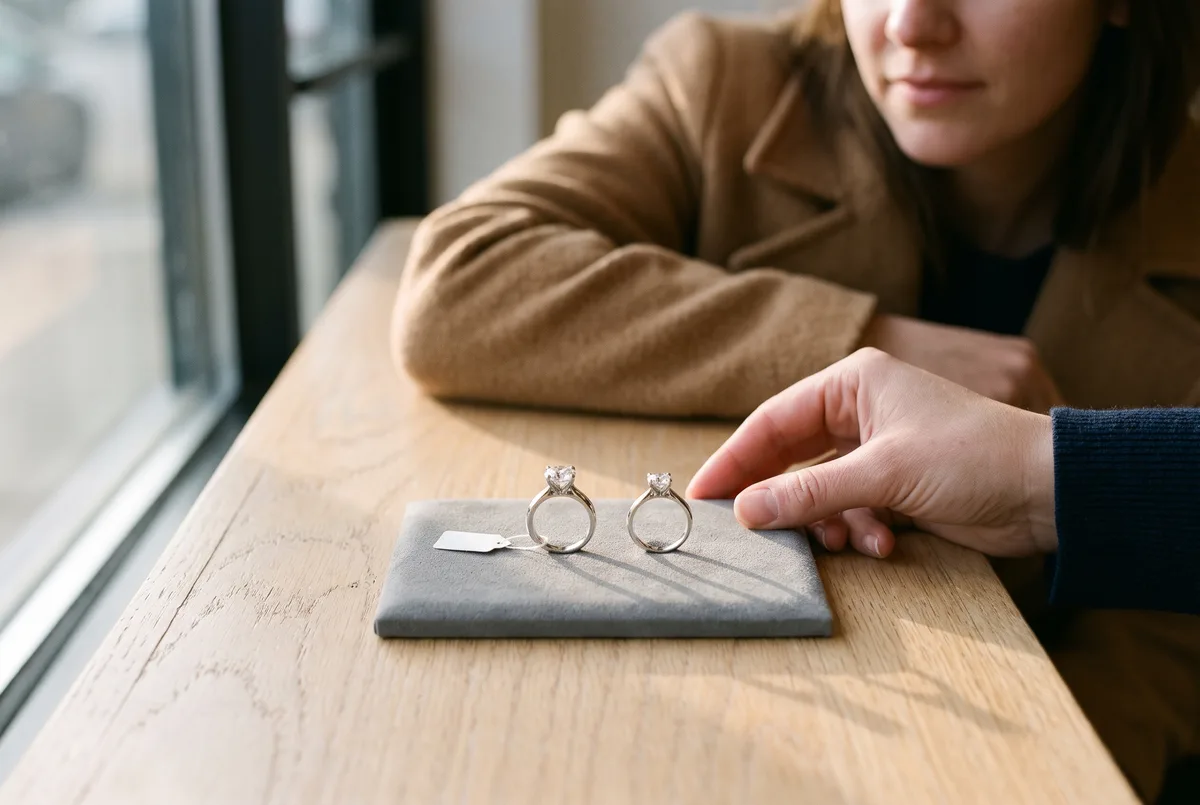
A customer with a fixed budget can now buy two very different rings. Spent on a lab-grown centre, the money buys a large, bright stone. Spent on a natural one, it buys a smaller stone with a mined origin. Both are diamond. What differs is the price, how fast that price moves, what you're allowed to call each one, and what the customer can expect if they ever sell it.
This guide is for store owners and buyers in the US, Canada, the UAE and India deciding how much of each to carry. It covers what's physically the same, dated price data from 2022 to 2026, margin risk, demand, disclosure rules by market, screening, resale, and a stock-mix table by store type. The purchase-order checks for lab-grown goods sit in a separate post, the lab-grown diamond jewellery wholesale checklist, so they aren't repeated here.
What's the difference between lab-grown and natural diamonds?
Origin, not material. The FTC's Jewelry Guides define a diamond as "a mineral consisting essentially of pure carbon crystallized in the isometric system" (16 CFR 23.12). The definition doesn't require the stone to be mined. A lab-grown diamond meets it, with the same hardness, refractive index and crystal structure as a natural one.
Almost all lab-grown diamond is made one of two ways. Chemical vapour deposition (CVD) builds the crystal layer by layer on a thin diamond seed plate in a chamber of carbon-bearing gas. High pressure, high temperature (HPHT) growth recreates, in a press, the conditions under which natural diamond forms. Neither method is a quality grade. IGI's lab-grown reports state which method was used and whether there's any sign of post-growth treatment.
Because the material is identical, you can't separate the two by eye or under a loupe. That takes detection equipment, and stones an instrument can't clear go to a gemmological laboratory. That fact drives disclosure, reports and how carefully you keep parcels apart.
| Lab-grown | Natural |
|---|---|---|
Material | Diamond: carbon in a cubic crystal | Same |
Origin | Grown by CVD or HPHT | Formed underground and mined |
How it's identified | Detection equipment or a lab report | Same; a report confirms natural origin |
Typical inscription | GIA: "Laboratory-Grown" plus number; IGI: "LG" number | Optional |
US wording | Qualifier such as "laboratory-grown" before "diamond" | "Diamond" alone |
Price direction since 2022 | Sharply down | Down, from a much higher base |
How have lab-grown vs natural diamond prices moved since 2022?
Lab-grown prices fell hard and natural prices fell too, from a much higher base. An AFP report found a lower-quality 1 ct lab-grown stone that cost about $2,400 in 2022 sold for just over $1,000 in 2023, and cited analyst Edahn Golan's estimate of a 58% fall in wholesale lab-grown prices that year.
Date | Measure | Figure | Source |
|---|---|---|---|
2022 → 2023 | Lower-quality 1 ct lab-grown, retail | About $2,400 → just over $1,000 | |
2023 | Lab-grown wholesale prices (Golan) | −58% | |
Q1 2025 | 1 ct lab-grown vs 1 ct natural (Zimnisky) | About $845 vs about $3,895 | |
FY2024-25 → FY2025-26 | India's average lab-grown polished export price | US$87.80 → US$60.14 a carat (−31.5%) | |
Q1 / Q2 2026 | Lab-grown midstream prices, year on year (Golan) | −14% / −13% | |
September 2026 | Average 1 ct natural (Rapaport) | $3,898, down 51% from 2021 |
Read the rows separately: a retail price, a wholesale index, an export average across every size and a single-size benchmark measure different things. Joining them into one curve would mislead. The export average, for example, falls when the mix shifts towards melee, so it says nothing about the price of a 1 ct centre.
The direction is still clear. In Q1 2025 a natural 1 ct cost roughly 4.6 times a lab-grown one ($3,895 ÷ $845 ≈ 4.6). The latest wholesale data hints at a slower fall rather than a floor: Golan's figures showed 1 ct rounds up 1% in Q2 2026, and JCK's August analysis described prices as possibly stabilising.
What does the price gap mean for retail margins?
Your lab-grown margin can shrink while the piece is still in the case. With lab-grown midstream prices down 14% year on year in Q1 2026 on Golan's figures, a ring priced from last year's cost can be undercut by a store that restocked later, without either of you changing your markup.
Here's an illustration with round numbers. You buy a lab-grown solitaire for $1,200: $700 for the stone, $500 for metal and making. Priced at keystone (twice cost), it sells for $2,400. A competitor buys the same ring after stone prices have dropped 14%. Their stone costs $602 ($700 × 0.86), so the ring costs $1,102, and keystone gives $2,204. They're $196 below you for an identical piece.
Now the cash side, using the same illustrative markup. A natural ring that costs $4,000 earns $4,000 of gross profit at keystone. The lab-grown ring above earns $1,200. You'd need to sell between three and four lab-grown rings (4,000 ÷ 1,200 ≈ 3.3) to match one natural sale. Lab-grown wins back ground on stock: fewer dollars sit in the case, and in US bridal it's what most couples now choose.
Three pricing habits follow:
- Price lab-grown on replacement cost. Set the shelf price from what the ring would cost you today, and review it at every reorder.
- Hold shallower depth in lab-grown. Keep core sizes and reorder against sales instead of buying a season upfront.
- Keep natural pricing on its own logic. Don't price natural as "lab-grown plus a premium"; the two move differently.
The invoice terms that support this, such as separate stone and metal lines and a repricing clause, are in the wholesale checklist. For a line-by-line cost build of a solitaire, see what jewellery costs to make.
Is demand shifting from natural to lab-grown diamonds?
In US bridal, decisively. The Knot's 2026 Real Weddings Study found lab-grown centre stones in 61% of engagement rings, up from 52% a year earlier and up 239% since 2020. Couples who chose lab-grown spent about $4,300 on average for a 2.0 ct centre, IDEX reported, against $7,000 for a 1.6 ct natural centre.
That's the sales story in two numbers. On those averages, lab-grown buyers spent $2,700 less ($7,000 − $4,300) and still came away with a centre 0.4 ct larger (2.0 − 1.6).
The study covers US weddings only. Trade data from other markets shows lab-grown volume rising much faster than value. DMCC reported 76.9 million carats of lab-grown diamond traded through the UAE in 2025, up 91.5%, while trade value rose 7.5% to US$1.3 billion. India's lab-grown polished exports rose 30.51% in carats in FY2025-26 but fell 10.55% in dollar value, on GJEPC's figures. We haven't found consumer survey data of The Knot's quality for UAE or Indian shoppers, so test a small range before committing depth there.
How must lab-grown diamonds be disclosed in each market?
The origin word travels with the word "diamond". In the US, the FTC Guides ask for "laboratory-grown", "laboratory-created", "[manufacturer]-created" or a phrase of like meaning immediately before "diamond", with equal conspicuousness (16 CFR Part 23, revised in July 2018). Section 23.27 bars "real", "genuine" and "natural" for lab-grown stones.
Market | Basis | Accepted wording | Watch for |
|---|---|---|---|
US | FTC Jewelry Guides, 16 CFR 23.25 and 23.27 | "laboratory-grown", "laboratory-created" or "[manufacturer]-created" immediately before "diamond", equally conspicuous | No "real", "genuine" or "natural" for lab-grown |
Canada | CJA guidelines (2020), built on the Competition Act | "lab-grown", "lab-created" or "synthetic" immediately before "diamond", same prominence | "Diamond" alone means mined; no value-holding claims |
India | IS 19469:2025, voluntary, effective 1 January 2026 | "laboratory-grown diamond", "laboratory-created diamond" | "Lab grown", "LGD", "lab-created", "man-made" and "cultured" barred; "synthetic diamond" only in trade documents where law requires it |
UAE | No lab-grown wording rule verified | Check with your adviser | Use the full "laboratory-grown diamond" on tags |
Canada has no lab-grown guidance from the Competition Bureau that we could find. The legal hook is the Competition Act's general rule: section 74.01 makes it reviewable conduct to make a representation to the public "that is false or misleading in a material respect". The Canadian Jewellers Association's guidelines, summarised by Jewellery Business, turn that into jewellery wording and add a warning that breaching the Act's marketing requirements could break the law.
India's standard, reported by IDEX, is voluntary and has no legal force on its own, but it costs nothing to follow. For the UAE, we couldn't verify a federal or Dubai rule specific to lab-grown wording, so take local advice. A single tag that reads "laboratory-grown diamond" satisfies the US and Indian lists and spells out Canada's "lab-grown". That's the safest shared default.
How do retailers keep natural and lab-grown diamonds apart?
Screen, inscribe and separate. The Responsible Jewellery Council's Code of Practices expects certified members who trade diamonds to get written warranties from suppliers and to test high-risk polished diamonds, loose and set, with effective detection equipment or through a qualified lab, at a point just before sale.
Melee is where mixing happens. A natural pavé band can carry dozens of stones too small for individual reports, and one lab-grown stone in the parcel turns the whole piece into a disclosure problem. Ask your manufacturer how natural melee is screened, on what equipment, and at what stage. The right answer is after the last point where stones could be swapped, not when the parcel was first bought.
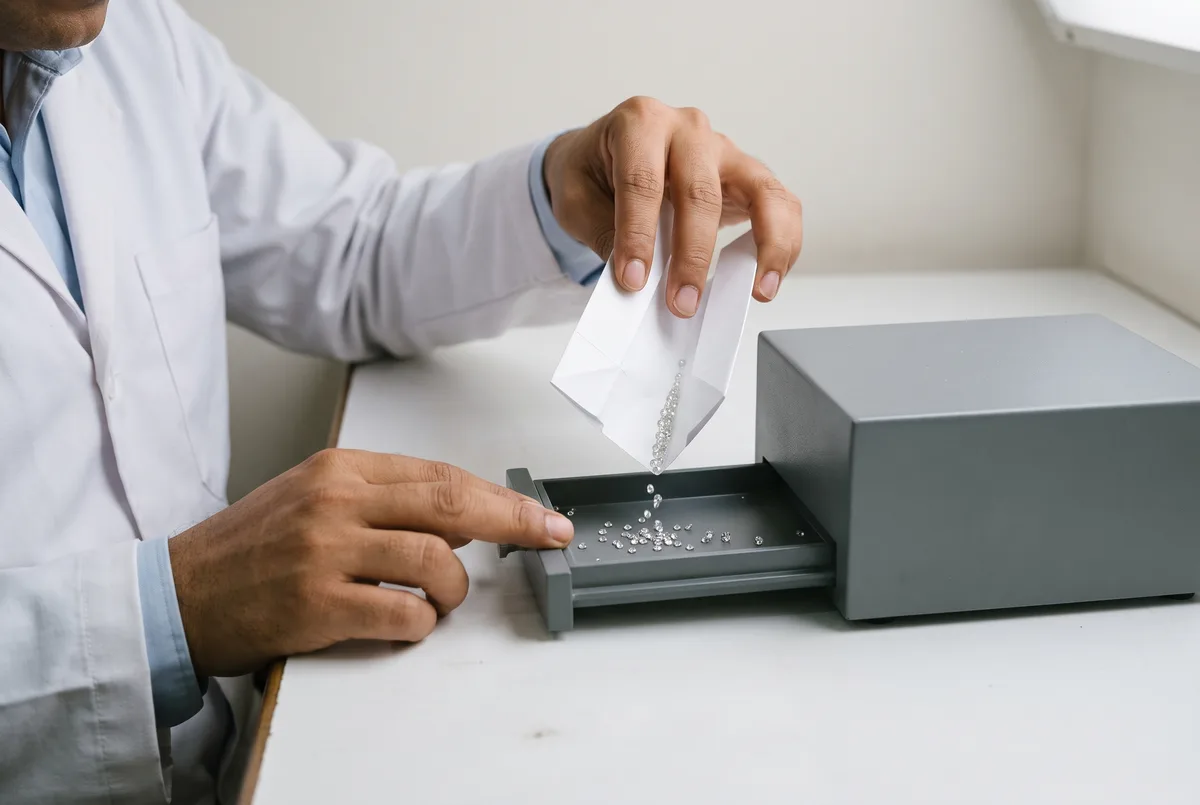
Centre stones are easier. GIA inscribes lab-grown stones it assesses with "Laboratory-Grown" and the report number, under the service it launched on 1 October 2025. IGI's lab-grown inscriptions carry an "LG" report number. Inscriptions on natural stones are optional, so a natural report without a matching inscription isn't a red flag in itself. For how the labs compare, see IGI vs GIA vs SGL reports.
Natural diamonds should also arrive on invoices carrying the World Diamond Council's System of Warranties statement, which covers polished stones and diamond-set jewellery as well as rough. In the store, keep the two lines on separate purchase orders, separate memo envelopes and separate trays.
Do lab-grown or natural diamonds hold their value?
Neither should be sold on that promise. The CJA's guidelines say claims that lab-grown diamonds retain or increase in value haven't been proven and can't be made. Natural stones have fallen too: Rapaport's average 1 ct natural price was $3,898 in September 2026, CNBC reported, 51% below 2021.
The resale market for lab-grown stones is limited. When a new replacement stone keeps getting cheaper, a used one has little to compete on, and the price table above shows how far new prices have moved since 2022. Natural stones are traded second-hand, but the September 2026 figure shows that a mined origin hasn't protected prices either.
What can staff say? Lab-grown is bought for size and price, natural for origin and rarity, and neither is an investment product. Put that line in sales training, and write any trade-in or upgrade terms down as dated store policy, not a promise made at the counter.
Lab-grown vs natural diamond: which stock mix suits your store?
It depends on who walks in. In US bridal, where lab-grown centres were in 61% of engagement rings in The Knot's 2026 study, a store without lab-grown misses most couples. A store with only lab-grown turns away the customer who asks for a mined stone. A practical approach is to stock both.
Store type | Suggested lean | Why | Watch |
|---|---|---|---|
US or Canadian bridal-led store | Lab-grown centres in depth from 1.5 ct up; natural in core sizes, with special orders above | Size for budget drives the sale | Replacement-cost pricing; reprice at each reorder |
Fashion and gifting lines | Mostly lab-grown in high-carat-weight pieces: tennis bracelets, eternity bands, studs | Total carat weight is high, so the stone saving is large | Keep any natural line on separate parcels and screened |
Heritage or heirloom jeweller | Natural-led, with lab-grown as a clearly separate line | Customers come for a mined stone | Separate displays and staff wording |
UAE retailer | Test lab-grown in a small range beside natural | Trade volume is rising fast; consumer data is thin | Agree tag wording with your adviser |
Indian retailer | Both, with IS 19469 wording and BIS-hallmarked gold | Voluntary standard in force since January 2026 | "Synthetic" only in trade documents |
Offering one design with either stone keeps the choice simple: the customer compares two centres, not two rings. Browse pieces by market on the US and India pages, or see our designs.
What to do next
Decide your lean by store type, then set three rules before the next order: replacement-cost pricing for lab-grown, one tag wording per market, and separate purchase orders for natural and lab-grown goods. Siona Jewels makes natural and lab-grown diamond jewellery, with typical production of 2–6 weeks. When you know the designs and quantities, ask for both prices on one brief and compare them side by side.
Planning a range?
Send us your designs, metals and quantities, and we’ll reply with a quote and timeline within one business day.
Questions buyers ask
Yes, with a difference. IGI grades lab-grown diamonds on colour, clarity, cut and carat. Since 1 October 2025, GIA no longer gives lab-grown stones 4C grades; it assesses D–J stones of 0.15 ct and above as Premium or Standard, at $15 per carat with a $15 minimum as of October 2026. Check current fees before quoting.
Only in some markets, and never on its own. In the US, 16 CFR 23.12 allows "cultured" for laboratory-created diamonds only with a clear and conspicuous qualifier such as "laboratory-created". India's IS 19469:2025 bars "cultured" altogether. For a tag shared across markets, "laboratory-grown diamond" avoids the problem entirely.
Only if you can back it up. The CJA's 2020 guidelines tell Canadian retailers to ask for substantiation of terms like "eco-friendly", "sustainable" and "carbon neutral", and to avoid vague environmental claims they can't verify. Ask your supplier for evidence first, and keep the claim specific to what that evidence shows.
Nobody can say. Golan's figures showed midstream prices down 13% year on year in Q2 2026, yet 1 ct rounds rose 1%. India's average lab-grown export price was US$67.32 a carat in September 2026, against a US$60.14 average for FY2025-26, on GJEPC data. Price on replacement cost and avoid deep loose-stone stock.
A report isn't what the FTC Guides turn on: they let a mined stone be called simply "diamond", and inscriptions on natural stones are optional. For centre stones, though, a report from a recognised lab is the evidence behind the word. Under the RJC code, certified members test high-risk polished diamonds before sale.