
GIA vs IGI vs SGL: which diamond report does a retailer need?
By Siona Jewels team · Updated
Short answer
For natural centre stones sold in the US and Canada, GIA is the report most buyers recognise. For lab-grown, IGI still issues full 4C grades, while GIA has given lab-grown stones only a Premium or Standard assessment since 1 October 2025. SGL, founded in London in 2007, is often used for jewellery sold in India.
Two diamonds can carry the same carat weight and very different reports. One has a GIA report that grades every C; another, lab-grown, comes back from GIA marked simply "Standard"; a third has an IGI report with a colour, clarity and cut grade for each. A buyer who treats these papers as interchangeable will misprice stock, or worse, sell a stone whose inscription doesn't match its paperwork.
This guide is for retail buyers and brand founders choosing which grading report to ask for on stones in their jewellery. It explains what GIA, IGI and SGL each do, how to read an IGI report line by line, what changed at GIA for lab-grown stones in October 2025, and how to check a report and inscription online. It ends with a decision table by market and size. Whether to stock lab-grown at all is in lab-grown vs natural: what retailers should stock.
What do GIA, IGI and SGL each do?
All three are independent laboratories that test whether a stone is diamond, whether it's natural or laboratory-grown, and describe its quality. They differ in history, reach and what they grade. The Gemological Institute of America says it created the International Diamond Grading System in 1953, the framework behind the 4Cs most buyers know.
IGI, the International Gemological Institute, dominates lab-grown grading. A report IGI commissioned from Redseer for its 2024 IPO filing gave it 65% of the lab-grown report market. That's IGI's own estimate, not an independent ranking. IGI went public in India in December 2024, and its revenue tells the same story: IDEX reported in July 2026 that lab-grown stones made up 66% of IGI's certification revenue.
SGL's roots are in London. According to SGL Labs, it was founded there in 2007, reports 25 locations in five countries, and runs centres in Mumbai, Surat, Hyderabad, Jaipur and Dubai. It issues diamond, lab-grown diamond, jewellery and gemstone reports, and it's often used for jewellery sold in India.
| GIA | IGI | SGL |
|---|---|---|---|
Background | Grading system created 1953 | Public company in India since December 2024 | Founded in London, 2007 |
Natural diamonds | Full 4C grading report | Full 4C grading report | Diamond reports |
Lab-grown diamonds | Premium or Standard assessment only (since 1 Oct 2025) | Full 4C grading report | Lab-grown diamond reports |
Where buyers know it best | Natural stones, US and Canada | Lab-grown stones, all four markets | Jewellery sold in India |
How to read an IGI certified diamond report
An IGI lab-grown report is laid out in a fixed order: identity, grading results, additional grading information, then comments. Each IGI lab-grown report prints "Report verification at igi.org" under its number, and the comments give the growth method. Read it top to bottom, in that order.
Identity. The top block gives the report date, the IGI report number, a description ("Laboratory Grown Diamond"), the shape and cutting style (for example, round brilliant) and the measurements in millimetres. Check the measurements against the stone with a gauge; a clear mismatch is a reason to stop.
Grading results. Carat weight, colour grade, clarity grade and, for rounds, cut grade. These are the four lines your price list hangs on, and they're the lines GIA no longer gives for lab-grown stones.
Additional grading information. Polish, symmetry and fluorescence, then "Inscription(s)", which records exactly what the laser wrote on the girdle. Beside these sit a proportions diagram (table, crown and pavilion angles, girdle thickness) and a clarity plot, with red symbols for internal features and green for external ones.
Comments. For lab-grown stones, this is where growth method and treatment appear. A typical line reads "This Laboratory Grown Diamond was created by Chemical Vapor Deposition (CVD) growth process," followed by "As Grown – No indication of post-growth treatment" or, where it applies, "Indications of post-growth treatment." That second phrase matters: treated colour should be disclosed on your tag and invoice.
The small print is worth one read. It states the report is not a guarantee, valuation or appraisal, so don't let anyone in your sales chain describe it as one. CVD and HPHT growth are explained in the lab-grown diamond jewellery wholesale checklist, so they aren't repeated here.
GIA vs IGI for lab diamonds: what changed in October 2025?
Since 1 October 2025, GIA no longer grades lab-grown diamonds on the 4Cs. Its Laboratory-Grown Diamond Quality Assessment sorts stones of 0.15 ct and above into Premium or Standard, at US$15 per carat with a US$15 minimum. IGI still issues full colour, clarity and cut grades.
GIA's reasoning is that most lab-grown production looks alike. The lab said in June 2025 that more than 95% of laboratory-grown diamonds entering the market fall into a very narrow range of colour and clarity. The criteria are strict at the top and broad below it.
| GIA Premium | GIA Standard | IGI lab-grown report |
|---|---|---|---|
Colour | D | E–J (D with VS clarity also qualifies) | Full colour grade |
Clarity | VVS or better | VS or better | Full grade, FL to I3 |
Polish and symmetry | Excellent | Very Good (Good symmetry for fancy shapes) | Graded |
Cut (rounds) | Excellent | Very Good | Graded |
Girdle inscription | "Laboratory-Grown" + number | "Laboratory-Grown" + number | Report number, usually with an "LG" prefix |
Below the criteria | No assessment; US$5 fee | No assessment; US$5 fee | Graded across the full scale |
What does that mean on the shop floor? An E VVS2 and a G VS1 can both read "Standard" from GIA. On IGI reports they're two different stones at two different prices. If your customers shop by colour and clarity grade, IGI's report carries the detail they compare. If they want a simple, recognised quality tier on a lab-grown stone, GIA's assessment is cheap and quick to budget: a 2 ct stone costs US$30 (2 × US$15).
Natural diamonds are a different matter. GIA's Diamond Grading Report still covers all 4Cs, a plotted clarity diagram and a proportions graphic, and GIA's fee schedule notes that every stone is tested for laser drilling, fracture filling and colour treatment.
Where does an SGL report fit?
SGL suits jewellery and lower-value stones sold in India more than loose centre stones bound for North America. SGL Labs lists diamond, lab-grown diamond, jewellery and gemstone reports, and has centres in Mumbai, Surat, Jaipur, Hyderabad and Dubai, close to where much Indian jewellery is made and sold.
A jewellery report describes a finished piece rather than one loose stone: total diamond weight, a quality range and the metal. For an Indian retailer selling a diamond bangle or a set of studs, that's often what the customer wants to see, alongside the BIS hallmark on the gold. For a US bridal buyer selling a 1.5 ct centre, it isn't enough on its own; the centre still needs its own report.
There's also the question of what your end customer recognises, and that varies by market. Ask your customers which reports they've seen and trust before you choose; a report nobody at the counter can explain adds cost without adding confidence.
How do you verify a report and its inscription?
Check three things every time: the report exists online, the number on the report matches the girdle inscription, and the stone's measurements match the paper. GIA's Report Check looks up any GIA report by number, and IGI reports carry "Report verification at igi.org" for the same purpose.
Inscriptions are the link between stone and paper, but they aren't foolproof. IGI has published a case in which it found a 6 ct lab-grown diamond carrying a natural-diamond inscription. That's why the lab's own testing, not the inscription alone, settles origin. If a high-value stone's paper and inscription disagree, send it back to the lab before you set it.
Natural stones are a special case. On GIA's natural Diamond Grading Report, laser inscription of the report number is available at an additional charge, not automatic. A natural stone with a valid report and no inscription isn't a red flag in itself; a lab-grown stone with none is. For centre stones, ask your supplier to inscribe as standard.
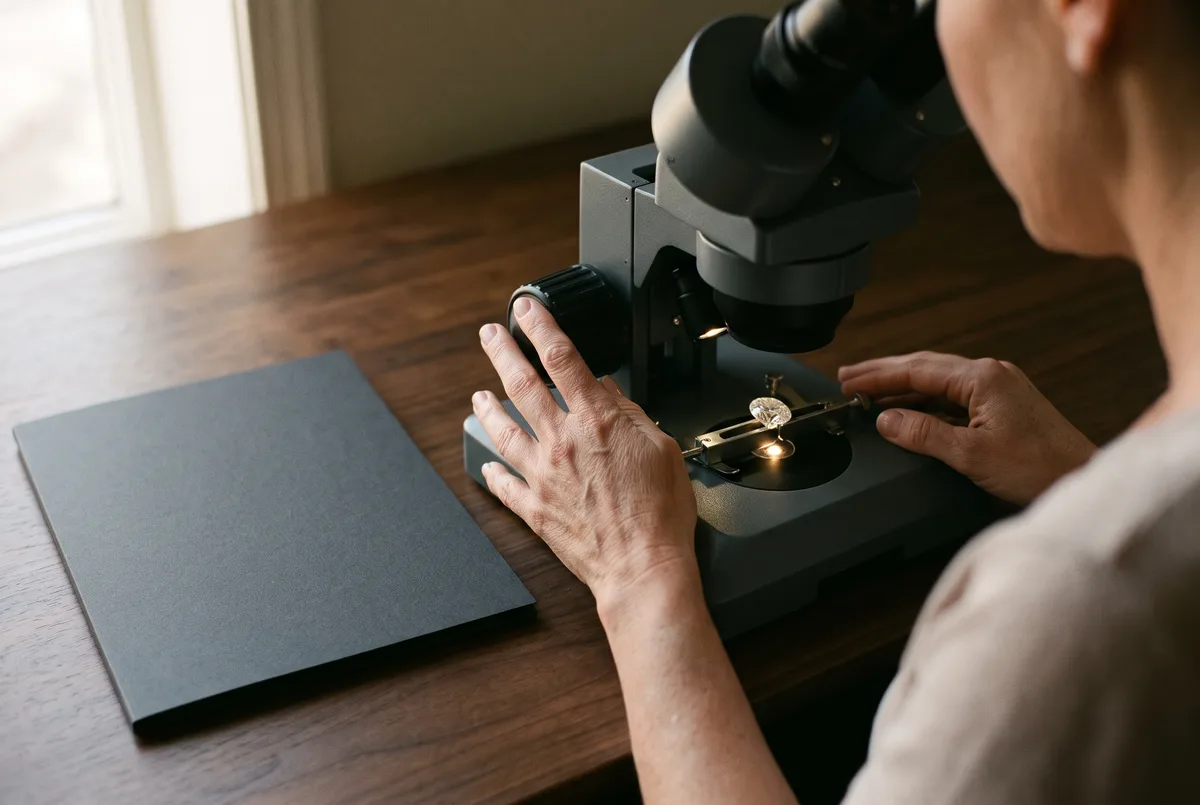
When the stone arrives already set, read the girdle at 10x under a loupe or microscope before the piece goes in the case. Record the report number against the SKU, so a returned ring can be checked against the same stone.
Report cost and turnaround: what to check before you quote
Don't build a margin on remembered fees. Labs publish schedules by region and update them; GIA's D-to-Z schedule for Hong Kong, for example, took effect on 1 July 2026, and its rush service returns results within 48 hours only "subject to availability".
The one fixed figure worth knowing is GIA's lab-grown assessment fee: US$15 per carat with a US$15 minimum. Small stones hit the minimum. Fifty 0.25 ct stones for a stud line cost US$750, because each one falls under the floor (0.25 × US$15 = US$3.75, so US$15 applies; 50 × US$15 = US$750). For natural reports and IGI reports, ask the lab or your supplier for the current schedule in your currency.
GIA reports can cost more and take longer than other labs for some services, but that depends on the stone, the service and the queue, so compare current quotes rather than relying on reputation. Pre-certified stones avoid the wait. If a stone isn't certified yet, add grading time to your order plan; the production timeline guide shows where it fits. The report fee then appears as its own line in what jewellery costs to make.
Which report should you buy for each market and stone size?
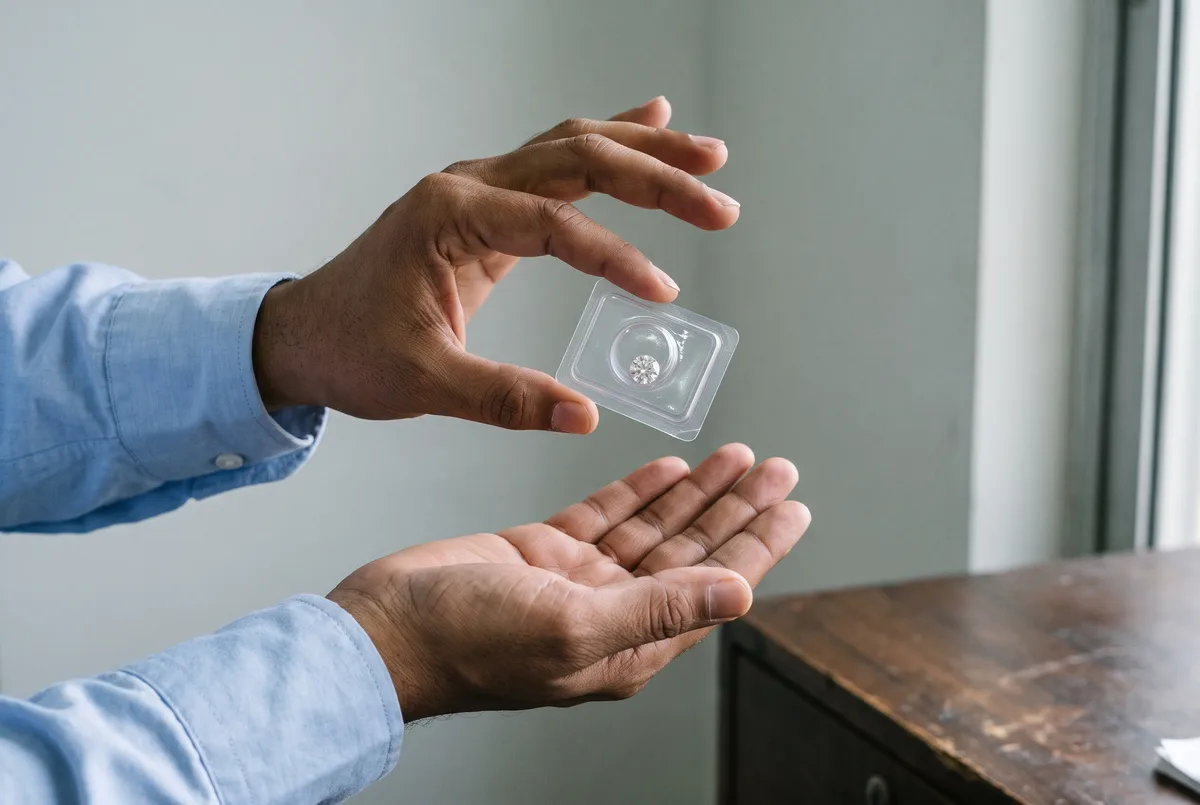
Match the report to what your customer will check and what the stone is worth. GIA's grading and assessment fees start at 0.15 ct in its published schedule, so stones below that are rarely reported one by one. Above it, the decision turns on origin, market and price.
Stone and market | Report to ask for | Why |
|---|---|---|
Natural centre stone, US or Canada | GIA Diamond Grading Report (with inscription) | The report most North American buyers recognise |
Lab-grown centre stone, any market, sold on grades | IGI lab-grown report | Full colour, clarity and cut grades |
Lab-grown centre stone, sold on a simple quality tier | GIA Laboratory-Grown Diamond Quality Assessment | Premium or Standard, at US$15 per carat |
Natural centre stone, UAE or India | GIA or IGI, by what your customers recognise | Both grade natural stones on the 4Cs |
Diamond jewellery for India | IGI or SGL jewellery report | Describes total weight and quality range of the piece |
Melee and accent stones | No individual reports; parcel screening and invoice description | Reports cost more than the stones are worth |
A single order can mix reports. A US bridal line might use IGI for lab-grown centres and GIA for a natural premium range, with melee described on the invoice. For lab-grown wording on tags and listings in each market, see the lab-grown diamond jewellery wholesale checklist.
What to do next
Write the report into the purchase order: the lab, the report type, inscription required or not, and who pays the fee. GIA's lab-grown assessment, for one, is US$15 per carat with a US$15 minimum, so small stones carry a fixed cost. Ask for report numbers before shipment and check them online.
On arrival, read each centre stone's girdle and match it to its paper. If you'd like certified centre stones set in your designs, tell us what you need.
Planning a range?
Send us your designs, metals and quantities, and we’ll reply with a quote and timeline within one business day.
Questions buyers ask
Not quite. For lab-grown stones, IGI gives full colour, clarity and cut grades, while GIA has given only a Premium or Standard assessment since 1 October 2025. For natural stones, both grade the 4Cs. Whichever you choose, price the stone on the report you'll actually hand the customer, not on a grade from another lab.
Yes. A stone below GIA's Standard criteria, such as colour below J, clarity below VS, or polish or symmetry below Very Good, gets no assessment at all. GIA still charges a US$5 evaluation fee. If you're submitting a mixed parcel, sort out stones that are clearly below Standard first, or send them to a lab that grades every quality.
IGI's do. The comments on its lab-grown reports state the growth method, CVD or HPHT, and either "As Grown – No indication of post-growth treatment" or a note that there are indications of post-growth treatment. Treated colour should be disclosed on your tag and invoice, so read the comments line before you write either.
No. Reports make sense for centre stones, where the paper changes the price. GIA's grading fees start at 0.15 ct. Melee and accent stones are screened in parcels and described on the invoice by total weight and quality range. For a finished piece sold in India, an IGI or SGL jewellery report can cover the whole item.
A recut stone needs a new report, because its weight and proportions change. GIA's fee schedule lists follow-up services, such as rechecks of colour or clarity, which must be requested before the stone is returned. Ask the lab directly for anything beyond a simple recheck, and keep the original report with the stone.