
Pricing and costs
Making charges on gold: how labour and wastage are priced
By Siona Jewels team · · 11 min read
Short answer
Making charges are the manufacturer's price for turning gold into jewellery: labour quoted per gram, as a percentage of metal value or per piece, plus a wastage allowance for metal lost at the bench. In India, the CBIC GST FAQ applies 3% GST to the total value, making charges included.
Put two quotes for the same 22K chain side by side and the gold line is usually close. Everything after it is not. One supplier bills labour per gram, another as a percentage of the metal, a third rolls wastage into a single "making" figure. The metal is priced off a public rate. The rest is where quotes drift apart, and where a buyer can overpay for months without noticing.
This guide comes from the bench side. It covers how a manufacturer builds the making charge, what wastage physically is, how billing between a manufacturer and a retailer differs from a shop bill, and how the same piece gets quoted to buyers in India, Dubai and the US. For the purity arithmetic behind each karat, see our gold karat guide by market.
What are making charges on gold?
Making charges are what a manufacturer bills for labour: design, casting, assembly, setting, polishing and finishing, kept separate from the gold itself. India's tax rules treat them as part of the jewellery's value. The CBIC GST FAQ for gems and jewellery (Q7) applies 3% GST to the total value, making charges included, even when they're shown as a separate line.
The FAQ's own example uses a chain carrying ₹2,000 of making charges. The point it makes is simple: the tax base is the full invoice value, not the gold alone. Splitting labour onto its own line doesn't change the rate. That rate was left unchanged when the GST Council moved most goods to two slabs on 3 September 2025, as reported after the 56th Council meeting.
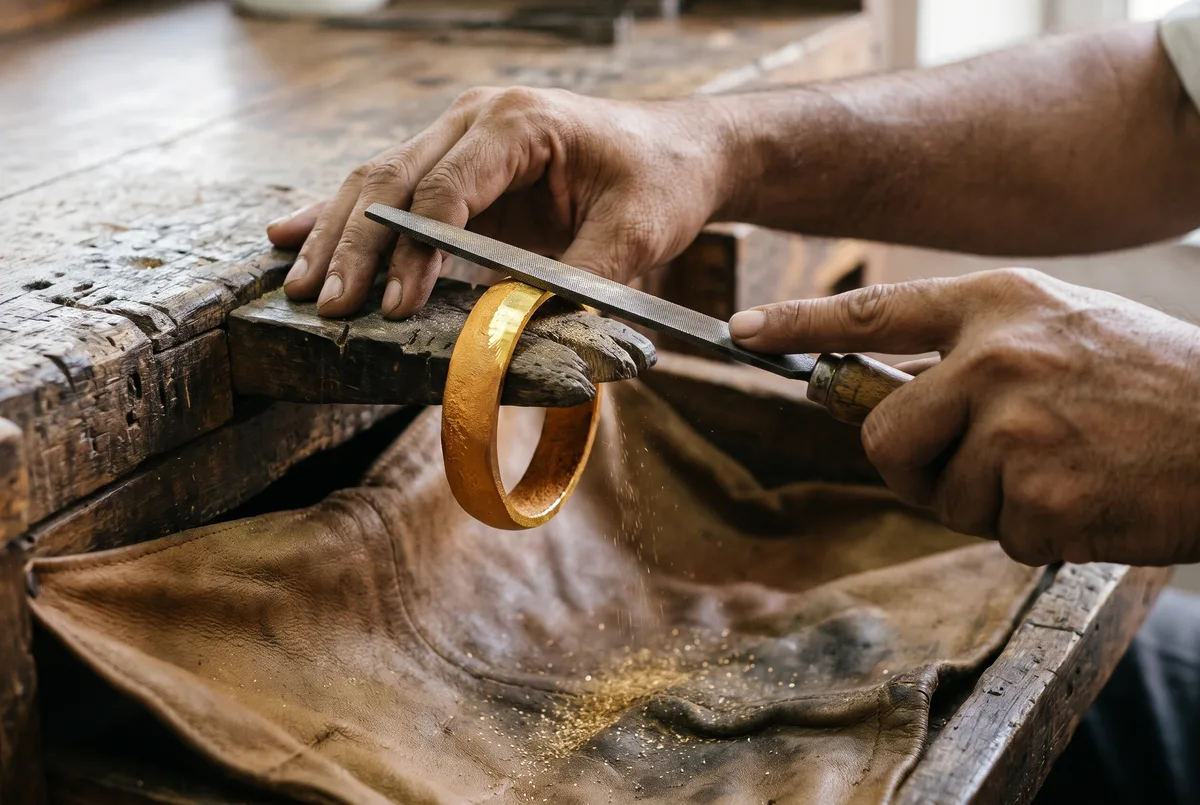
Inside the making charge sits every stage after the metal is bought: CAD and model, casting, filing, soldering, stone setting, polishing, plating and quality control. If you want to see those stages in order, our post on how jewellery is made, from CAD to hallmark walks through them. For pricing, what matters is that each stage costs hours, and some designs need far more of them than others.
How are making charges on gold calculated: per gram, percentage or per piece?
Manufacturers quote making charges in three ways: a rate per gram of finished weight, a percentage of the metal value, or a flat price per piece. No regulator sets the rates. The CBIC FAQ fixes only the tax treatment (3% on the total), so the method is a commercial choice you can negotiate.
Method | How it works | Suits | Watch for |
|---|---|---|---|
Per gram | Labour rate × finished gold weight | Plain chains, bangles, repeat plain-gold lines | A heavier version of the same design costs more labour for similar work |
Percentage of metal value | Labour = a % of the gold value on the day | Shop counters, mixed retail stock | Labour rises whenever gold rises, though the work hasn't changed |
Per piece | One flat price per item | Studded, light or intricate pieces; export quotes | Check exactly what's included: setting, rhodium, hallmarking, stamping |
The percentage method deserves a closer look in a year like this one. The World Gold Council's full-year 2025 summary puts the Q4 2025 average gold price at $4,135/oz, up 55% on a year earlier. A making charge set as a percentage of metal value would have risen by the same 55% on an identical piece. The karigar's hours didn't change at all.
For B2B work, per gram is the cleanest basis for comparing suppliers because it separates the work from the metal. Per-piece pricing is fine too, if you can back out the per-gram labour.
Why does a plain chain cost less to make than filigree or studded work?
Labour follows hours and risk, not grams. A machine-made chain spreads its setup across long runs, while filigree and studded pieces need hand assembly, stone setting and more inspection. That gap matters more as pieces get lighter: World Gold Council data showed Q2 2026 jewellery demand down 17% by weight, while its value rose 22% in the first half of the year.
Lighter pieces mean labour is a bigger slice of each price. The things that push labour up are mostly visible in the design:
- Machine versus hand work. Chain made on machines runs continuously; hand-made links, filigree wire and granulation are built piece by piece.
- Components and joints. Every solder joint is a step, a check and a place where the piece can fail.
- Stones. Each stone is seated and set by hand, and pavé or micro-pavé multiplies that by dozens.
- Finish. Rhodium, two-tone plating, texture and enamel each add a stage.
- Rework risk. Complex pieces fail QC more often, and the manufacturer prices that in.
We haven't given percentage ranges here because no reliable published source has them, and the spread between designs is wide. What works in practice: ask every supplier for labour per gram on each line, even when the final price is per piece. Two filigree earrings quoted at the same piece price can hide very different labour rates once you divide by weight.
What is wastage in gold, and why is it on the quote?
Wastage is the allowance for gold that leaves the piece during production: filings, polishing dust, cut-off sprues and metal lost in melting. Much of it is recovered from catch-skins, floor sweeps and polishing extraction and sent for refining, but not all of it, and refining costs money. No tier-one source publishes standard wastage percentages, so treat any "standard" figure with care.
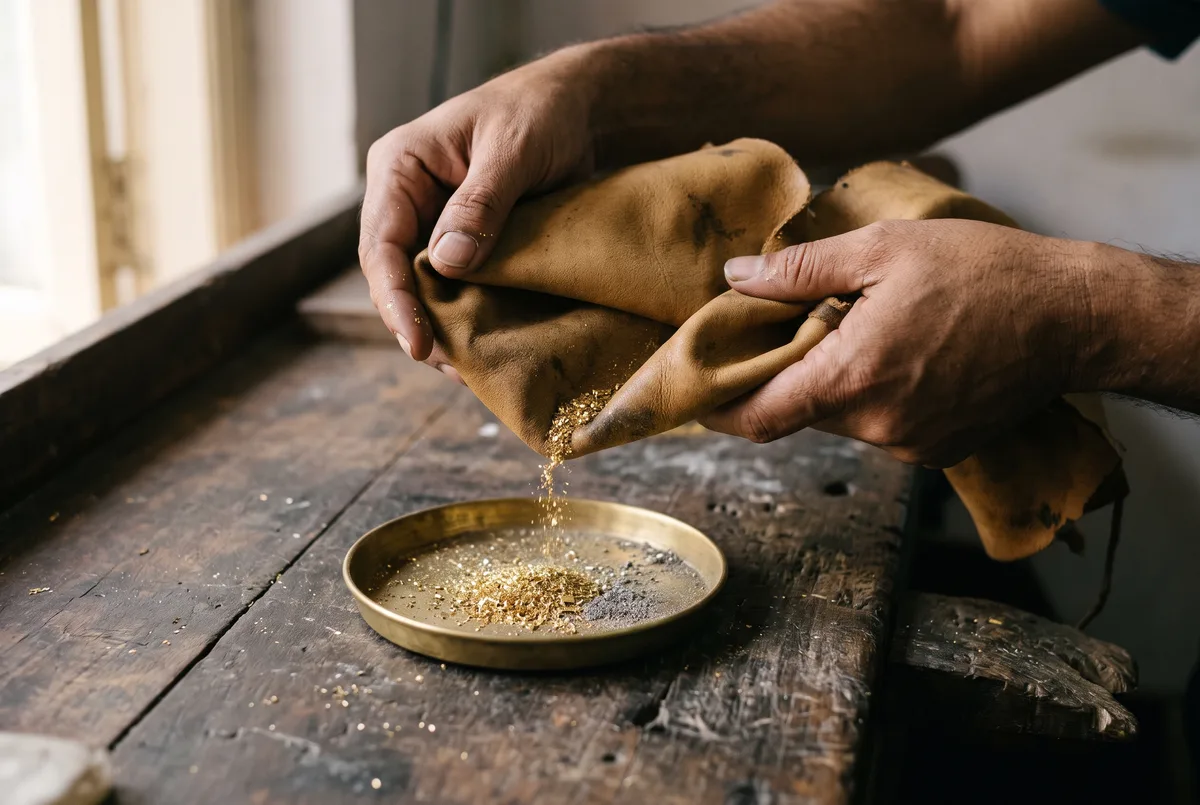
Here is where the metal goes, stage by stage:
- Casting. Sprues and buttons are cut off and remelted. Most of that metal comes back, though each melt loses a little.
- Filing and assembly. Filings fall onto the leather catch-skin under the bench peg and are collected.
- Polishing. Fine dust goes into the polishing motor's extraction and is recovered from the filters.
- Cleaning and sweeps. Wash water, floor sweeps and old aprons are kept and sent to a refiner.
A quote lists wastage because the manufacturer carries the gap between what goes in and what comes back from the refiner, and pays the refining cost on top. On one chain the numbers look small: every 0.1 g of 22K wastage is 0.0916 g of fine gold. At 0.1 g a piece, a 50-piece order adds up to 5 g of 22K, or 4.58 g fine.
When you read the wastage line, check three things. Is it charged in grams of fine gold or as a percentage? Is it calculated on net weight (gold only) or gross weight (including stones)? And is it already inside the making charge, so you aren't paying for it twice?
How is B2B billing different from a retail bill?
Between a manufacturer and a retailer, gold and labour are often settled separately. The buyer pays for metal at the day's rate or supplies it on account, and pays labour per gram. Tax follows that split: CBIC's FAQ (Q8) puts job work on gold supplied by the principal at 5% GST on the job charges, with input tax credit available.
Metal on account (gold-for-gold)
In a gold-for-gold arrangement, the retailer deposits fine gold with the manufacturer and the account is kept in fine grams. A 10 g 22K chain draws 10 × 0.916 = 9.16 g of fine gold from the account, plus the agreed wastage in fine grams. You pay cash only for labour and charges, so your gold price risk stays with you rather than the supplier.
Labour and tax on job work
When the manufacturer works on your gold, it's job work. The 22nd GST Council meeting in October 2017 set job work on Chapter 71 goods at 5%; diamond job work was later cut to 1.5% from October 2019. A current rate table still shows 5% for jewellery job work and 1.5% for diamonds. The FAQ's reverse-charge answer for unregistered job workers predates a 2019 change to the law, so ask your tax adviser how it applies now.
Hallmarking per piece
Hallmarking is billed per article, not per gram. Under the BIS (Hallmarking) Amendment Regulations 2026, notified on 14 September 2026, the fee rose from ₹45 to ₹75 per article, with a ₹200 minimum per consignment, paid to the assaying and hallmarking centre with taxes extra. A 50-piece order costs 50 × ₹75 = ₹3,750. A two-piece consignment would come to ₹150, so the ₹200 minimum applies.
How are making charges on gold quoted in Dubai and the USA?
The cost build-up is the same everywhere, but how it's presented changes. Dubai buyers are used to seeing a making charge per gram on top of the gold, and the UAE–India CEPA cut duty on Indian jewellery from 5% to 0% from 1 May 2022. US buyers more often see one price per piece.
Making charges on gold in Dubai and the UAE
For the UAE, a quote usually reads like an Indian trade quote: gold weight and karat, the gold basis, a per-gram making charge, and stone and setting lines. With duty at zero under CEPA, the comparison comes down to labour, wastage and freight. Ask for the same per-gram breakdown you'd expect in Mumbai.
Making charges on gold in the USA and Canada
Pieces for North America are often made in 14K or 10K, and buyers there tend to get a single per-piece price. That price still contains gold, wastage, labour, stones and finishing, so ask which gold price it assumes and on what date. Two more points matter:
- Stamping. Under 15 U.S.C. §297(b), a piece carrying a quality mark such as "14K" must also carry a trademark or name, and the rule reaches importers too.
- Duty. As of October 2026, GJEPC puts the total US duty on Indian gold jewellery at about 15.5–16%: a 10% Section 301 duty from 24 July 2026 plus the 5.5–6% MFN rate. Tariffs are moving, so check the current position and see our post on US import duty on jewellery from India.
Canadian duty depends on the tariff line, so confirm it with CBSA or your broker. Our shipping guide for the US, Canada and UAE covers the paperwork.
Worked example: what does a 10 g 22K chain cost?
Take a 10 g 22K chain with an illustrative 24K rate of ₹10,000 per gram. That's a round number picked for easy maths, not a current rate. 22K is 91.6% fine, so the chain holds 9.16 g of fine gold worth ₹91,600 before labour, wastage, hallmarking and GST.
The labour and wastage figures below are placeholders too, picked so the arithmetic is easy to follow. They are not typical rates.
Line | Basis | Working | Amount |
|---|---|---|---|
Gold | 22K = 91.6% fine | 10 g × 0.916 × ₹10,000 | ₹91,600.00 |
Wastage | 0.2 g of 22K (placeholder) | 0.2 × 0.916 × ₹10,000 | ₹1,832.00 |
Labour | ₹500/g (placeholder) | 10 g × ₹500 | ₹5,000.00 |
Taxable value |
|
| ₹98,432.00 |
GST at 3% | CBIC FAQ Q7 | 3% × ₹98,432 | ₹2,952.96 |
Hallmarking | ₹75 per article, taxes extra | 1 × ₹75 | ₹75.00 |
Total |
|
| ₹101,459.96 |
We've shown the hallmarking fee as a pass-through outside the 3% base. Since BIS says taxes on the fee are extra, confirm how your supplier invoices it.
Now the same chain on gold-for-gold terms. You supply 9.16 g + (0.2 × 0.916) = 9.3432 g of fine gold. Cash due is labour of ₹5,000 plus 5% job-work GST of ₹250, plus the ₹75 hallmark: ₹5,325 in all, before tax on the hallmarking fee.
Two more lessons sit in this table. First, ₹5,000 of labour on ₹91,600 of metal is about 5.46%. Quoted as a percentage instead, a 10% rise in gold would lift labour to ₹5,500 for the same chain. Second, each ₹100/g difference in labour is ₹1,000 per chain, or ₹50,000 on a 50-piece order.
What should a manufacturer's quote for gold jewellery show?
A usable quote shows the gold basis, weights, wastage, labour and charges as separate lines, so you can check each one. For India, the IBJA rate is polled twice a day, around noon and 5 pm IST, and published for 999, 995, 916, 750 and 585 purities, including import duty but excluding GST and making charges.
Line | How it's priced | What to check |
|---|---|---|
Gold rate | IBJA (India) or the LBMA Gold Price (USD) | Which publication, which date, and how long the rate holds |
Gold weight | Grams, net of stones | Net versus gross weight; tolerance on the finished weight |
Purity | Karat and fineness (e.g. 22K = 91.6%) | Matches the hallmark or quality stamp for your market |
Wastage | Grams of fine gold or % | Basis weight; not also inside the making charge |
Making charge | Per gram, % of metal, or per piece | Per-gram equivalent for comparing suppliers |
Stones and setting | Per stone or per carat, plus setting per stone | Quality, count, total carat weight, certificate |
Hallmarking or stamping | ₹75 per article in India; trademark stamp for the US | Whether it's included or billed separately |
Tax | 3% GST on sale; 5% on job work (check current rate) | Correct rate for the billing structure |
Validity | Days, or until gold moves by a set amount | What happens if you confirm late |
If a supplier won't break out these lines, you can't compare their quote with anyone else's. That alone tells you something.
What to do next
Send the same design to each shortlisted supplier and ask for gold weight, wastage and labour per gram as separate lines, with the gold basis and date named. Decide early whether you'll buy metal or supply it on account, because that changes both cash flow and tax.
Siona quotes BIS-hallmarked gold for India and trademark-stamped pieces for the US and Canada, and can take a design from a single piece for bridal. If you're still choosing suppliers, our guide to sourcing private-label jewellery from India covers vetting, samples and terms. You can also browse current designs to get a reference weight before you ask for prices.
Planning a range?
Send us your designs, metals and quantities, and we’ll reply with a quote and timeline within one business day.
Questions buyers ask
Grams of fine gold are easier to audit. A percentage hides the basis: it might apply to net weight, gross weight or metal value. If a supplier quotes a percentage, ask them to convert it to grams of fine gold for one sample piece. Then you can compare it directly with other quotes and check it against invoices later.
Not automatically. Labour depends on the design's hours and risk, not on purity. A 14K piece contains 58.5% fine gold against 91.6% for 22K, so its metal line is lower, but the filing, setting and polishing take similar time. If anything, a percentage-based making charge looks cheaper on 14K only because the metal value is smaller.
Often, yes. Repeat orders reuse the CAD file, moulds and set-up already paid for, and production teams get faster on familiar designs. The saving shows up mostly in per-piece setup costs rather than per-gram labour. Ask for a two-tier quote: first run and repeats. Then you can see how much of the price was one-off work.
Per-gram and per-piece labour are normally fixed at confirmation for the quoted design. The gold line is not, unless you fix the metal price or supply gold on account. Percentage-based making charges move with gold, which is one more reason to convert them to per gram before you sign. Put the agreed basis in writing on the order.