
Shipping jewelry from India to the USA, Canada and the UAE
By Siona Jewels team · Updated
Short answer
Jewellery leaves India on a customs shipping bill, by insured courier or valuables carrier, with a commercial invoice, packing list and diamond warranty statement. As of October 2026 the US charges duty on every shipment, Canada charges 6.5% on gold jewellery plus GST, and the UAE charges 0% under CEPA with an Indian certificate of origin.
A finished order sitting in a Mumbai vault isn't stock yet. Before it reaches your counter it has to clear Indian export customs, travel insured, and clear customs again at your end, where duty, tax and marking rules all differ by country. Get one document wrong and the parcel waits in a bonded warehouse while someone emails for a corrected invoice.
This guide follows a shipment from the exporter's desk in India to a retailer in the United States, Canada or the United Arab Emirates, as of October 2026. It covers what the exporter files, the paperwork that travels with the goods, duty and tax in each market, samples, marking rules, and who pays under the common delivery terms. It's a plain-language summary, not customs advice. Rates change, so confirm each shipment's classification and rate with a licensed customs broker.
Export jewellery from India: what the exporter files
Every export from India needs an electronic entry. Section 50 of the Customs Act, 1962 requires the exporter to present a shipping bill (or a bill of export) on the customs automated system and to ensure the information in it is accurate and complete. Customs then assesses it and allows the goods out.
For a jewellery exporter, three things sit behind that filing. The first is registration. The Gem & Jewellery Export Promotion Council issues a Registration-cum-Membership Certificate (RCMC) on admission, and the Foreign Trade Policy asks for one when an exporter applies for a licence or claims a benefit under the policy. It's an export registration, not a quality certification, so don't read it as one.
The second is where the goods leave from. Many Mumbai units sit inside SEEPZ, the special economic zone in Andheri, and export under zone procedures. The GJEPC's SEZ report puts SEEPZ's gem and jewellery exports at US$3,371.70 million in 2023–24, 52.60% of everything India's SEZs shipped in the sector. Units outside the zones clear through ordinary customs at the airport or courier terminal.
The third is the carrier. Finished jewellery travels either by insured express courier or by a specialist valuables carrier that moves high-value goods door to door under its own security.
Courier is simpler for small, frequent consignments, and it got easier this year: from 1 April 2026 the ₹10 lakh per-consignment cap on courier exports was removed, according to the GJEPC. For large or very high-value consignments, a valuables carrier is the usual alternative. Ask your supplier which it uses for your order, and why.
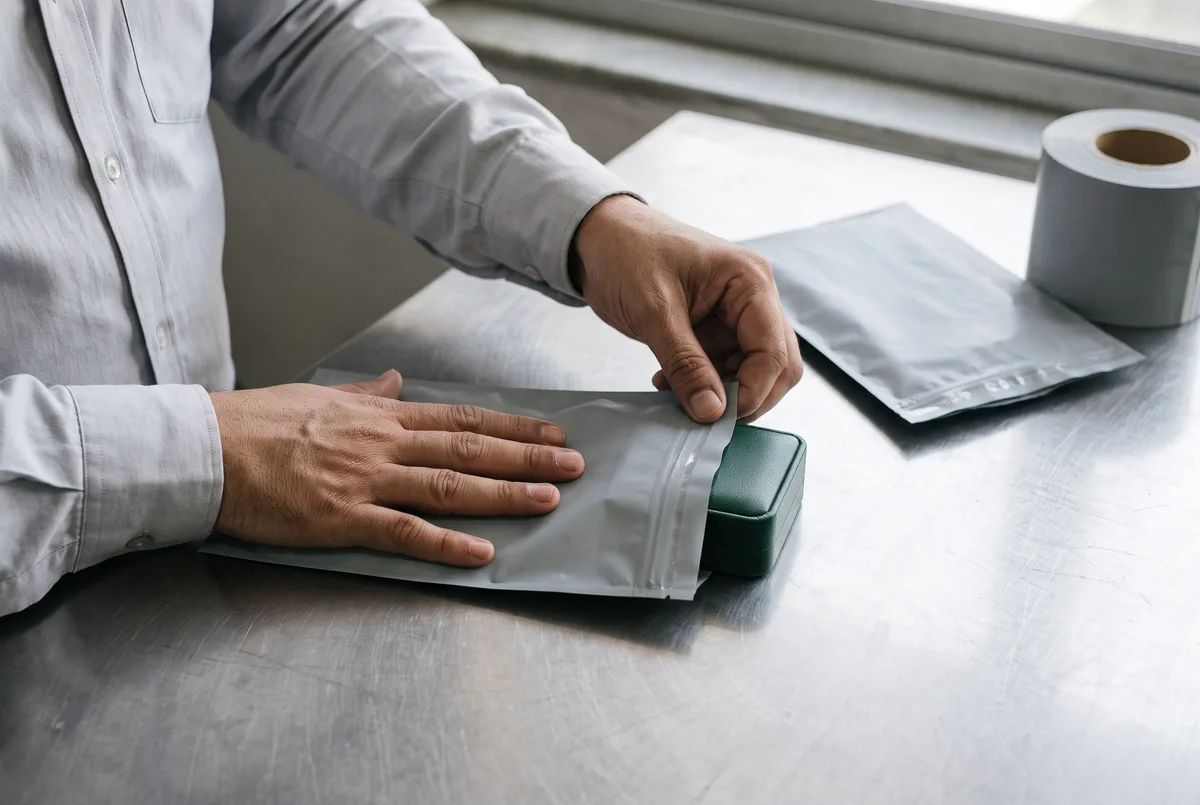
Paperwork for every shipment
The commercial invoice does most of the work at the border. For US entries, 19 CFR 141.86 requires a detailed description of each item, quantities, the per-item price and currency, the country of origin, itemised charges, and any moulds or other production help supplied but not included in the price. It must be in English or carry a translation.
The table sets out what normally travels with a jewellery consignment to all three markets.
Document | What it shows | Why it matters |
|---|---|---|
Commercial invoice | Each line's description, metal and karat, stone type and weight, quantity, unit value, currency, HS code, origin | The basis for classification and duty; content set by 19 CFR 141.86 for the US |
Packing list | What sits in each sealed parcel, by line and piece count | Lets customs and your receiving team check parcels against the invoice |
Certificate of origin | That the goods are Indian-made under a trade agreement's rules | Needed for the UAE's 0% CEPA rate; not needed for a preferential rate in the US or Canada, since India has none there |
System of Warranties statement | The World Diamond Council's wording that the diamonds are conflict-free | Applies every time natural diamonds change hands, loose or set; the Kimberley Process itself covers rough diamonds only |
Lab-grown declaration | Lab-grown stones described as laboratory-grown on every line | Keeps the invoice consistent with FTC wording in the US and with what you'll put on the tag |
Grading reports | IGI or GIA report numbers for certified centre stones | Lets you match each report to its stone on arrival |
Keep the invoice line structure consistent with how you'll sell. If silver and gold pieces share a carton, put them on separate lines: they carry different codes and rates in both the US and Canada.
What does shipping jewelry from India to the USA involve in 2026?
Every commercial shipment to the US needs a formal customs entry and pays duty, whatever its value. The $800 de minimis exemption was suspended for all countries on 29 August 2025, the Court of International Trade upheld that on 13 August 2026, and the exemption is repealed by statute from 1 July 2027, as Troutman Pepper Locke summarises.
Most finished gold jewellery from India pays a 5.5% base duty under HTS 7113.19.50, plus a 10% Section 301 duty on Indian goods in force since 24 July 2026 under USTR's final action. On a $10,000 invoice that's $1,550 before broker fees. Chains, rope necklaces and silver carry other base rates. Our US import duty explainer walks through the codes, the 2026 changes and a worked example, so this guide won't repeat them.
Samples are the one place where duty can still be avoided. Pieces used only for taking orders can enter free under a temporary importation bond, subheading 9813.00.20. Under 19 CFR 10.31 the bond is 110% of the estimated duties and fees, and you declare that the pieces aren't imported for sale. The same section accepts an ATA carnet in place of the entry.
Either way, the samples have to go back out. If you plan to keep them, or sell them at the end of a trunk show, budget for duty from the start.
Marking is the other US rule to settle before goods leave India. If a piece carries a quality mark such as "14K", 15 U.S.C. §297 requires the maker, dealer or importer to apply a trademark (registered or applied for) or a name, by the same method and at least as large as the quality mark.
Siona stamps the buyer's trademark alongside the karat mark on US and Canada orders. Whoever makes your pieces, put the exact mark and its position on the purchase order, because a stamp is easy to add at the bench and awkward to add once pieces are sitting in a US warehouse.
What is the jewelry import duty in Canada?
Gold jewellery from India pays 6.5% under Canada's most-favoured-nation rate for tariff item 7113.19.90, and silver jewellery 8.5% under 7113.11.90, according to the CBSA's 2026 customs tariff. India isn't on the list of countries entitled to the General Preferential Tariff, so the MFN rate applies.
Tax comes on top. The 5% GST, or the federal part of the HST, is charged at import on the value of the goods plus duty. For commercial goods heading to an HST province, the provincial part isn't collected at the border; the Canada Revenue Agency explains that the importer may have to self-assess it on the GST/HST return, and that registrants can generally claim input tax credits. Your broker or courier collects duty and GST on delivery.
Here's the arithmetic on a C$10,000 shipment of 14K gold pieces. Duty at 6.5% is C$650. GST at 5% applies to C$10,650, which is C$532.50. That's C$1,182.50 at the border, before brokerage, and the GST is usually recoverable for a registered retailer.
Marking is optional in Canada, but it has conditions. Under the Precious Metals Marking Act, a quality mark such as "14K" may only be applied with a trademark that's registered or applied for in Canada. The regulations set 9K as the minimum for a gold quality mark. Send your trademark details with the purchase order, not after the goods land.
How does the UAE treat jewellery from India?
Indian jewellery enters the UAE at 0% customs duty under the India–UAE Comprehensive Economic Partnership Agreement, instead of the usual 5%, provided it meets the rules of origin and travels with a certificate of origin. The GJEPC's CEPA briefing notes that DGFT offices and export inspection agencies issue these certificates for jewellery.
The first zero-duty gold and jewellery shipments under CEPA reached the UAE in May 2022, so this route is well used. The practical rule is simple: no certificate, no preference. Ask for the certificate to be issued before dispatch and checked against the invoice, because a mismatch in description or value can cost you the 0% rate on that shipment.
VAT works differently from Canada's GST. Jewellery is standard-rated at 5% in the UAE. When a VAT-registered dealer sells gold or diamond jewellery to another registered trader who'll resell it or use it in manufacture, the seller doesn't charge VAT and the buyer accounts for it, as the Federal Tax Authority's guidance was reported by Khaleej Times. Investment-grade gold of 99% purity or more is zero-rated, per Gulf News, but finished jewellery isn't, even in 22K or 24K.

Who pays duty: DAP or DDP?
Under DAP (delivered at place), the seller delivers to your door and the buyer handles and pays for import clearance, including duty and tax. Under DDP (delivered duty paid), the seller does both export and import formalities and pays the duties. The ICC Academy cautions that DDP leaves the seller responsible for clearance problems at your end.
For a retailer, DAP has real advantages. It keeps you as the importer, so you control the broker, the classification and the duty bill, and you can reclaim GST in Canada or account for VAT in the UAE in your own name.
DDP looks simpler on a quote but folds duty into the price, which makes it harder to see what a rate change would do to your cost. Is the convenience worth the loss of visibility? For a first small order it may be. For a regular range, usually not.
Insurance follows the same logic. Under DAP, risk stays with the seller until the goods are at your disposal at the named place, so the seller normally insures the transit. Confirm in writing that cover is for the full invoice value, door to door, and check whether the carrier's own liability is limited for jewellery. A carrier receipt isn't an insurance policy.
How do the three markets compare?
All three markets tax jewellery from India differently, and the paperwork that secures the best rate differs too. The US adds a 10% Section 301 duty to its base rate, Canada applies its MFN rate plus GST, and the UAE drops duty to zero with a CEPA certificate. The table summarises the position as of October 2026.
| United States | Canada | UAE |
|---|---|---|---|
Base duty, most gold jewellery | 5.5% (HTS 7113.19.50) | 6.5% (7113.19.90) | 5%, or 0% under CEPA |
Extra duty on Indian goods | 10% Section 301 since 24 Jul 2026 | None | None |
Tax at import | No federal sales tax | 5% GST; provincial HST self-assessed | 5% VAT; reverse charge between registered traders |
Document that lowers duty | None available for India | None available for India | CEPA certificate of origin |
Low-value exemption | None; every shipment needs entry | Ask your broker | Ask your clearing agent |
Quality-mark rule | Trademark or name with any karat mark (§297) | Trademark registered or applied for in Canada; 9K minimum | Follow local assay rules; ask your buyer |
Typical courier transit | About a week; varies by carrier | About a week; varies by carrier | A few days; varies by carrier |
The transit times are typical door-to-door ranges for insured express services, not promises; customs holds, public holidays and a first shipment to a new importer all add days. Which karats sell in each market, and how they're marked, is covered in the gold karat guide.
What to do next
Start with the next order, not a general policy. Agree DAP or DDP in writing, name the insured party, and ask your supplier for a draft commercial invoice before production finishes, so your broker can check codes and descriptions while there's still time to change them.
Build your dates back from the day stock has to be on display, using the custom production timeline, and add shipping and clearance on top. If your range mixes natural and lab-grown stones, the lab-grown vs natural guide covers how to describe each. Market specifics are on the US, Canada and UAE pages, and you can ask for a landed-cost estimate on a specific order.
Planning a range?
Send us your designs, metals and quantities, and we’ll reply with a quote and timeline within one business day.
Questions buyers ask
Not any more. From 1 April 2026, CBIC Circular 17/2026 and Notification 08/2026-Customs removed the earlier ₹10 lakh per-consignment cap, so registered couriers can carry consignments of any value, the GJEPC reported. Carriers still set their own insurance and value limits, so check those before booking.
Returns need care. The 2026 courier reforms brought in a risk-based approach for most re-imports of rejected or returned goods, but the GJEPC noted that precious and imitation jewellery exported through e-commerce was specifically excluded. Agree a returns process with your supplier before the first order, including who pays freight and duty.
Not to cut the duty. India has had no US preference since the GSP programme lapsed at the end of 2020, and it isn't a GPT beneficiary in Canada. The country of origin still has to be on the invoice, though, as 19 CFR 141.86 requires for US entries.
Describe them as laboratory-grown on every line, with stone weight and quantity. In the US, the FTC's Jewelry Guides call for a qualifier such as "laboratory-grown" immediately before the word "diamond". Matching your invoice wording to your tag wording avoids questions at the border and at the counter.
Under DAP, the seller does until the goods are at your disposal at the agreed destination, according to the ICC's description of the rule. That's why the seller usually buys the transit insurance. Ask to see the policy's cover for jewellery and the declared value before you approve dispatch.