
Pricing and costs
How much does it cost to make jewelry? A manufacturer's breakdown
By Siona Jewels team · · 10 min read
Short answer
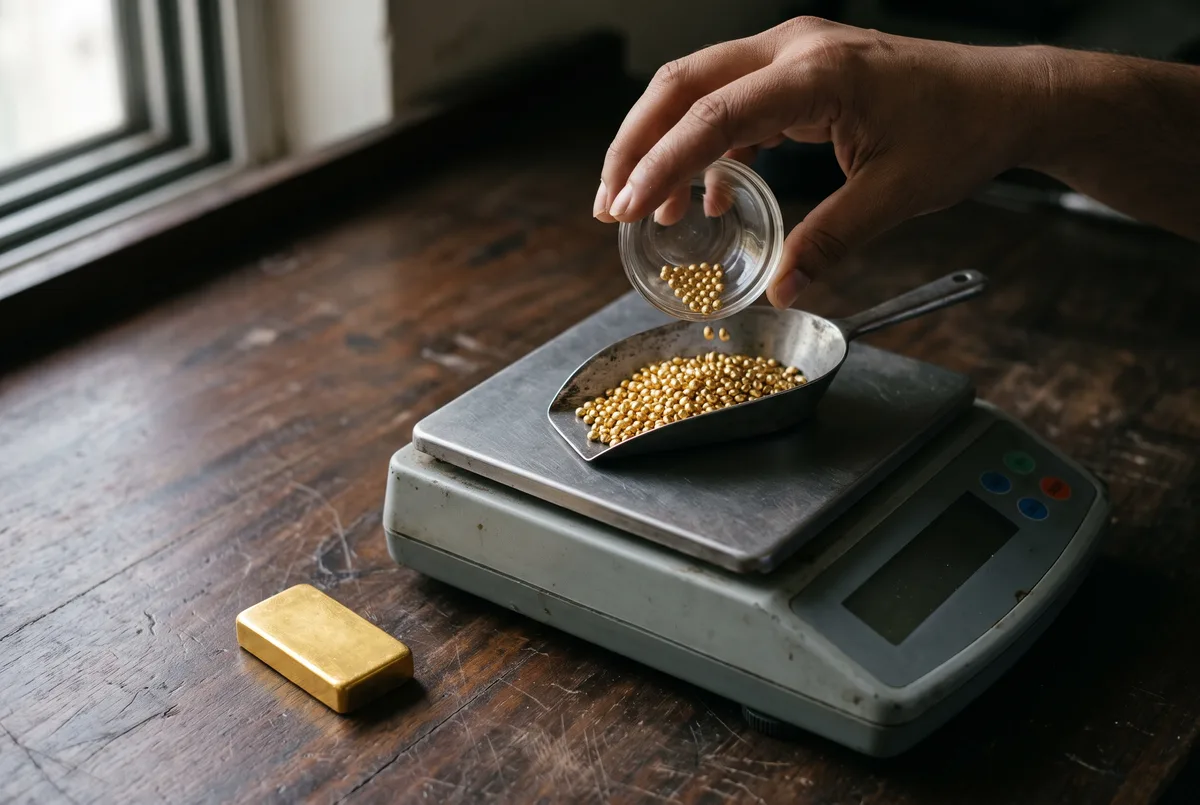
A fine-jewellery piece costs its gold at the day's rate plus metal loss, labour, stones, setting, finishing, certification, stamping, packaging, freight and duty. With gold at $4,032/oz on 23 October 2026, a 3 g 14K ring held about $228 of gold, and a 1 ct lab-grown centre averaged $845 in Q1 2025.
Most buyers see one number on a quote: the piece price. A manufacturer sees ten or so costs stacked underneath it. Some are fixed the day the order is confirmed, and some move every trading day. Knowing which is which tells you what you can negotiate and what you can only time.
This breakdown follows one hypothetical ring, a 14K solitaire with a 1 ct lab-grown centre, from bar gold to the retailer's shelf price. Where a sourced figure exists, we use it and date it. Where none exists, we use a symbol instead of inventing a number.
How much does it cost to make jewelry, line by line?
A fine-jewellery piece costs its metal at the day's rate, a metal-loss allowance, labour, stones, setting, finishing, certification, hallmarking or stamping, packaging, freight and duty. Gold is the easiest line to check. With spot gold at $4,032/oz on 23 October 2026, a 3 g 14K ring holds about $228 of gold.
Cost line | What drives it | When it's fixed |
|---|---|---|
Gold | Weight × purity × day's rate | Moves daily until fixed |
Metal-loss allowance | Grams lost in casting, filing and polishing, partly recovered | Moves with gold |
Labour (making) | Hours, design complexity, rework risk | At quote |
Stones | Type, size, quality; lab-grown or natural | At quote or memo date |
Setting | Per stone, by setting style | At quote |
Finishing | Polish, rhodium, plating, texture | At quote |
Certification | Lab fee schedule by carat | Changes rarely |
Hallmarking or stamping | Per article (India); trademark stamp (US) | Changes rarely |
Packaging and freight | Per piece and per shipment | Per shipment |
Duty | Destination tariff | Can change by policy |
The two lines that move are the ones buyers most often miss: gold and duty. For how labour and wastage are built up, see our post on making charges on gold.
How do jewellery manufacturers price the gold?
Manufacturers price gold as the day's published rate times the fine-gold content. Internationally, that's the LBMA Gold Price, set in US dollars at two daily auctions (10:30 and 15:00 London) run by ICE Benchmark Administration. It replaced the London Gold Fix on 20 March 2015. In India, IBJA publishes polled rates for each purity.
To get a per-gram figure, divide the ounce price by 31.1035, the grams in a troy ounce. At $4,032/oz that's $4,032 ÷ 31.1035 = $129.63 per gram of fine gold. Then multiply by the gold's purity:
Karat | Fine gold | Fine gold in 3 g | Value at $129.63/g |
|---|---|---|---|
10K | 41.7% | 1.251 g | $162.17 |
14K | 58.5% | 1.755 g | $227.50 |
18K | 75.0% | 2.250 g | $291.67 |
22K | 91.6% | 2.748 g | $356.22 |
Which karat you choose depends on your market, and our gold karat guide by market covers that. The same design in 18K costs $64.17 more in metal than in 14K at this rate, before any other change.
One detail that trips buyers up: the gold weight should be net of stones. A metric carat is 0.2 g, so a ring weighed with its 1 ct centre reads 0.2 g heavier than its gold. The metal-loss allowance then sits on top, usually stated in grams of fine gold or as a percentage. Ask which.
Why are jewellery quotes only valid for a short time?
Quotes expire quickly because the biggest input moves every day. The World Gold Council counted 53 record highs in the LBMA PM price during 2025, with a Q4 average of $4,135/oz, up 55% year on year. The run continued into the new year.
Gold passed $5,000/oz for the first time in January 2026, and by 23 October Fortune reported spot at $4,032, down 2.5% on a year earlier. Run our 3 g 14K ring at $5,000/oz and the gold line is $160.75 × 1.755 = $282.12. At $4,032 it's $227.50. That's a $54.62 swing per ring from gold alone, or $2,731 across a 50-piece order.
A manufacturer has three ways to handle that risk:
- Fix at confirmation. The gold price is locked when you confirm the order and pay any deposit. The supplier carries the risk from that point.
- Price at dispatch. Labour and stones are fixed; gold is billed at the rate on the invoice date. You carry the risk.
- Supply metal on account. You deposit fine gold and pay only for labour and charges. Common in India, less so for export.
Production takes weeks, so the gap between quote and dispatch is real. Ask any supplier which method applies, which rate (LBMA or IBJA, and which session), and what happens if you confirm after the quote lapses.
What do labour, setting and finishing add to the cost?
Labour is priced by hours, and design sets the hours. One dated US illustration comes from MJSA (June 2022): a bench jeweller billing CAD at $60 an hour charged $225 for a pendant that took just under four hours to model, and flush-set stones at $15 each. Factory pricing in India is structured differently, but the logic is the same.
A plain band is mostly casting and polishing. A solitaire adds a head, a seat cut for the stone, prong setting and a final polish around the setting. A halo or pavé ring adds dozens of small stones, each seated and set by hand under a microscope. Labour rises with every one of them.
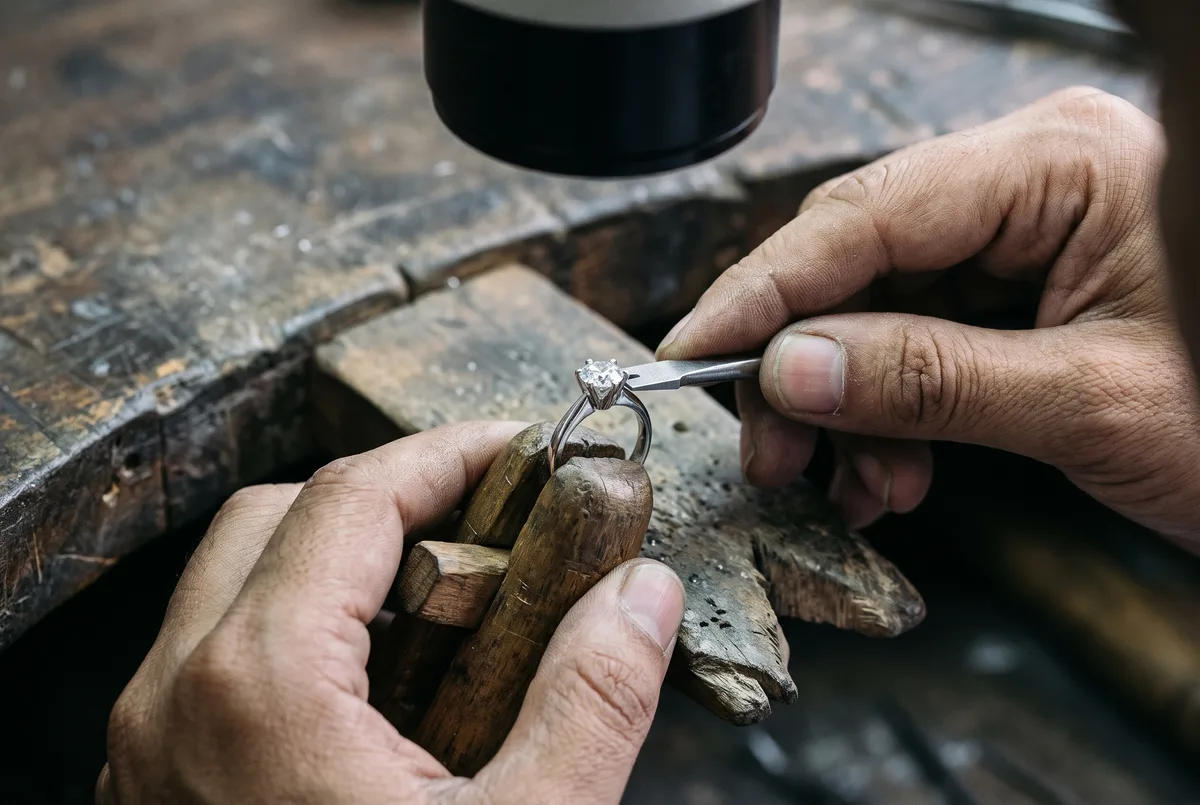
Finishing is the line that's easiest to overlook. White gold is usually rhodium-plated to brighten it, two-tone pieces need masking and selective plating, and matte or hammered textures are extra steps. None of these have published standard rates, so ask for them as separate lines rather than folded into "making".
How much of the cost is the diamond?
On a 1 ct solitaire, the centre stone is usually the largest single line. Paul Zimnisky's data reported by CNBC put an unbranded 1 ct lab-grown diamond at about $845 in Q1 2025, against roughly $3,895 for natural. That's about 4.6 times the price for natural.
Natural prices have fallen too. Rapaport's average for a 1 ct natural stone was $3,898 in September 2026, down 51% from 2021, according to CNBC. Lab-grown prices kept sliding into 2026: JCK, citing analyst Edahn Golan, reported wholesale lab-grown prices down 14% year on year in Q1 and 13% in Q2. Yet 1 ct rounds rose 1% in Q2, and some Chinese producers raised rough prices by 30% or more.
JCK's reading is that prices are possibly stabilising. That's a hedge, not a forecast. For a buyer, it means the $845 figure is a dated reference point, and your current memo price may differ. Ask for the stone price as of the quote date.
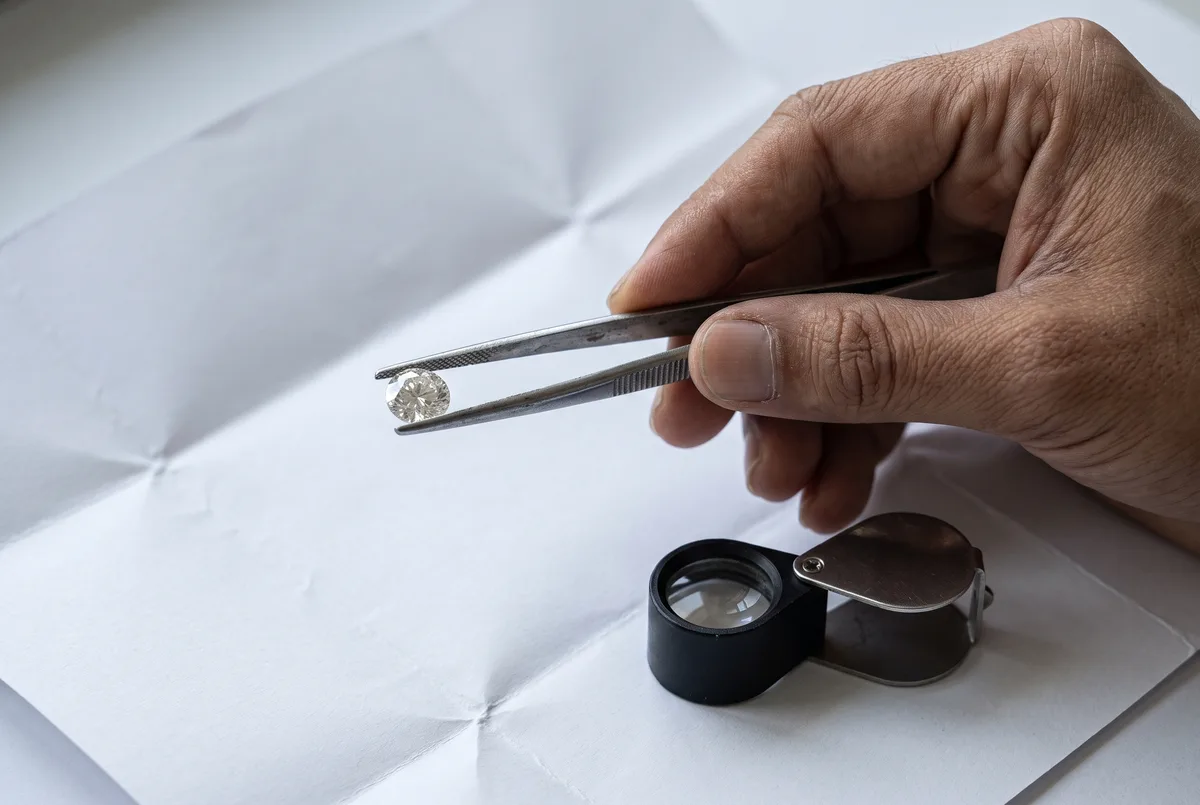
Which stone suits your store is a merchandising decision as much as a cost one. Our guide to lab-grown vs natural diamonds for retailers covers stock mix and disclosure, including the FTC's "laboratory-grown" wording rules.
What do certification, hallmarking and stamping cost?
Certification is priced per stone, hallmarking per article. Since GIA's October 2025 change, lab-grown stones get a Laboratory-Grown Diamond Quality Assessment rather than a 4Cs grade, at $15 per carat with a $15 minimum. For a 1 ct centre, that's $15.
Natural diamond reports are priced from GIA's published fee schedules by carat band, and the lab charges more for expedited service. The fee is small next to the stone, but the choice of lab affects how buyers read the report. Our comparison of IGI, GIA and SGL reports covers what each one tells a buyer.
Marking rules depend on the market:
- India. BIS hallmarking now costs ₹75 per article, regardless of weight, with a ₹200 minimum per consignment. Our making charges post has the detail and the arithmetic.
- US. Under 15 U.S.C. §297, a piece stamped with a quality mark such as "14K" must also carry a trademark or name. The rule reaches importers, so the stamp goes on at the factory.
What do freight and import duty add?
Duty is the line most likely to change. As of October 2026, GJEPC estimates total US duty on Indian jewellery at about 15.5–16%: a 10% Section 301 duty from 24 July 2026 plus the 5.5–6% MFN rate. For the UAE, CEPA cut duty on Indian jewellery to 0% from 1 May 2022.
The US position has shifted more than once this year. The Supreme Court struck down the IEEPA tariffs on 20 February 2026, a temporary Section 122 surcharge followed, and a 10% Section 301 duty replaced it on 24 July. Check the current rate before you price a US order, and see our post on US import duty on jewellery from India for the detail. For Canada, confirm the duty rate with CBSA or your broker.
Freight for fine jewellery moves as insured valuable cargo. It's usually charged per shipment, so its cost per piece falls as order size grows. Packaging works the same way: boxes, pouches and branded inserts are a per-piece cost that's easy to forget in a margin plan.
Worked example: what does a 14K lab-grown solitaire cost to make?
For a 3 g 14K solitaire with a 1 ct lab-grown centre, the sourced lines total $1,087.50. That's $227.50 of gold at the 23 October 2026 price, $845 for the stone at its Q1 2025 average, and $15 for a GIA assessment. Lines with no reliable published rate are shown as symbols.
Line | Basis | Working | Amount (USD) |
|---|---|---|---|
Gold | 3 g 14K, net of stone, at $129.63/g fine | 3 × 0.585 × $129.63 | $227.50 |
Metal-loss allowance | Grams of fine gold | M × $129.63 | M |
Labour | CAD, casting, assembly, polish | Per piece or per gram | L |
Centre stone | 1 ct lab-grown, Q1 2025 average | Zimnisky via CNBC | $845.00 |
Setting | Four or six prongs, one stone | Per stone | S |
Finishing | Polish; rhodium if white gold | Per piece | F |
Certification | GIA lab-grown assessment, $15/ct | 1 ct × $15 | $15.00 |
Packaging and freight | Per piece share of shipment | Per order | P |
Ex-factory total |
|
| $1,087.50 + M + L + S + F + P |
US duty, about 15.5–16% | On the known $1,087.50 alone | 15.5% to 16% | $168.56 to $174.00 |
Swap the centre for a natural 1 ct stone at Rapaport's $3,898 September 2026 average and the stone line rises by $3,053. The known subtotal becomes $4,140.50, and duty on it grows to between $641.78 and $662.48. The two stone figures are from different dates, so treat the gap as indicative.
Two lessons stand out. On a lab-grown solitaire, the gold and the unknown labour lines matter far more than they do on a natural one. And because duty is charged on value, the natural version pays almost four times as much duty on the same metal.
How does a wholesale price become a retail price?
Retailers usually price from their landed wholesale cost. Keystone, the long-standing rule of thumb, means retail equals 2 × wholesale, which gives a 50% gross margin. A ring bought at $1,600 retails at $3,200 under keystone, and the $1,600 difference is 50% of the selling price.
Markup and margin get mixed up all the time. A 50% markup on that $1,600 ring gives $2,400 retail. The $800 profit is only 33.3% of the selling price, not 50%. When a supplier, a partner or a spreadsheet says "50%", check which one it means.
Two more things move a retailer's real margin. One is replacement cost: if gold rises after you buy, restocking the same ring costs more, and a keystone price set on old stock no longer covers it. The other is stone prices: when lab-grown prices fall, stock bought earlier carries a higher cost than a competitor's newer stock. Price reviews tied to gold and stone movements protect against both.
What to do next
Ask each supplier for a line-item quote on the same design: net gold weight and karat, metal-loss allowance, labour, stone and setting, finishing, certification and stamping. Name the gold basis and date. Agree how the metal is fixed before you confirm, because Siona's typical production runs two to six weeks, and gold can move a long way in that time.
If you're building a new line from scratch, our post on starting a fine jewellery brand with a manufacturer covers samples, minimums and the order of decisions.
Planning a range?
Send us your designs, metals and quantities, and we’ll reply with a quote and timeline within one business day.
Questions buyers ask
In a plain band, gold usually dominates, because labour is mostly casting and polishing. At $129.63 per gram of fine gold, a 3 g 14K band holds $227.50 of metal before any work. Labour grows as a share when pieces get lighter or more detailed, which is why lightweight designs feel expensive per gram.
Usually because they've priced different things. One may use an older gold rate, quote gross weight including stones, or include setting and rhodium in labour. Another might quote a different stone quality. Line up net gold weight, karat, gold basis and date, stone specification and labour per gram before comparing totals.
Partly. Gold and stones cost the same per gram and per carat whether you order five pieces or fifty. What falls is the one-off work: CAD, moulds and setup are spread across more pieces, and freight per piece drops. Ask suppliers to separate one-off costs from per-piece costs so you can see the real saving.
For melee and small accent stones, individual reports rarely make commercial sense, and GIA's lab-grown assessment only covers stones of 0.15 ct and above. For centre stones, a report supports the retail price and the customer's confidence. Decide by stone size and price point, and specify the lab in your purchase order.