Sourcing and private label
How to start a fine jewelry brand with a manufacturer
By Siona Jewels team · · 10 min read
Short answer
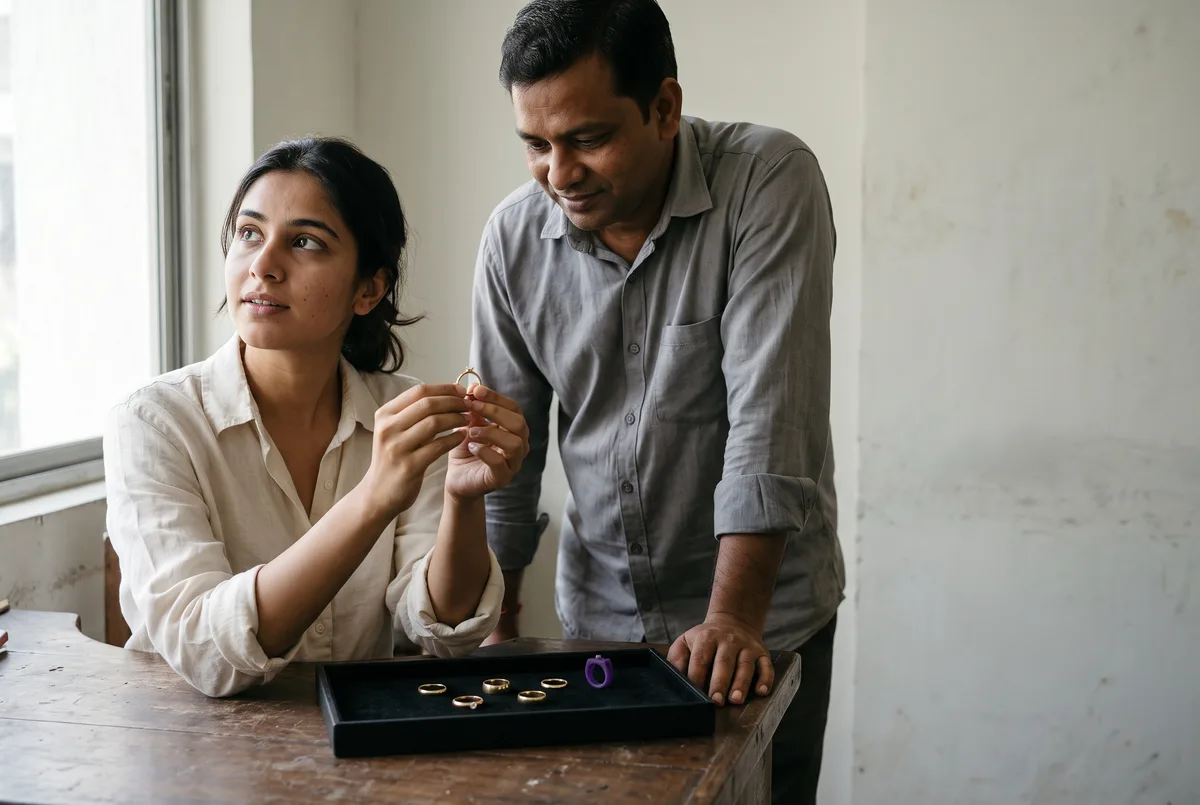
Start with your markets and karat, choose lab-grown or natural stones (lab-grown centre stones were in 61% of engagement rings in The Knot's 2026 study), then take each design through CAD, a resin prototype and a metal sample before the first production order. Budget per design, fix your gold price at order, and plan compliance for each market.
The hard part of a fine jewellery launch is rarely the idea. It's the stretch between the sketch and the first delivery: a CAD file that needs a fourth revision, a sample that comes back heavier than the costing assumed, a gold price that moved between quote and order. This guide is for founders launching a gold or diamond line, not silver or fashion jewellery, who plan to work with a manufacturer rather than build a workshop.
It runs in the order the decisions have to be made: markets and karat, stones, the path from design to production, the budget, gold price exposure, compliance in the US, Canada, India and the UAE, and the questions to put to a manufacturer before you sign. Where a cost has a published figure, it's linked. Where it doesn't, the budget table says "ask for a quote" rather than guessing.
Which markets and karat should a fine jewellery brand start with?
Choose markets first, because karat follows the market and drives metal cost. A karat is a 24th part, so 10K is 41.7% gold, 14K 58.5%, 18K 75% and 22K 91.6%. India's BIS hallmarking grades are 9K, 14K, 18K, 20K, 22K, 23K and 24K, with 9K added in July 2025, so 10K isn't one of them.
A 4 g ring makes the difference concrete. In 10K it holds 1.67 g of fine gold (4 × 0.417). In 14K it holds 2.34 g, in 18K 3.00 g, and in 22K 3.66 g. Same design, same CAD file, and the gold content more than doubles between 10K and 22K. The price gap follows the gold.
Positioning narrows the choice further. Decide what the brand is for (bridal, everyday fine jewellery, gifting) and the price band a hero piece should sit in. Then work backwards from that price to a karat and a stone budget, rather than designing first and costing later.
Two guardrails help. The gold karat guide covers which karats sell in each market. In the US, 10K is the usual entry point, though the FTC's Jewelry Guides accept karat marks as low as 9K.
Should a new fine jewellery brand use lab-grown or natural diamonds?
For bridal, lab-grown is now the majority choice. The Knot's 2026 Real Weddings Study found lab-grown centre stones in 61% of engagement rings among couples who married in 2025, up from 52% a year earlier. Couples who chose lab-grown spent about $4,300 on average for a 2.0 ct centre stone, IDEX reported, against $7,000 and 1.6 ct for natural.
That doesn't settle it for every brand. Natural stones carry a different story and often a different customer, and some brands run both: lab-grown for larger centre stones, natural for a smaller heritage line. The lab-grown vs natural guide sets out the trade-offs from a stocking retailer's side.
For a start-up, the sharper issue is inventory risk. Lab-grown wholesale prices have fallen hard over the past few years, so a brand holding loose lab-grown stock can watch its value slide before the stones are ever set. Buying stones against confirmed orders, or letting the manufacturer source them per order, keeps that exposure small.
Disclosure isn't optional. The FTC Jewelry Guides expect a lab-grown stone to be described as "laboratory-grown", "laboratory-created" or "[manufacturer name]-created", clearly and next to the word "diamond". Build that wording into product names, tags and listings from day one, not after launch.
Which grading reports should you use?
For larger centre stones, the report is part of what the customer buys. Which lab to use, and how the reports differ, is covered in IGI vs GIA vs SGL reports. Small melee stones generally aren't graded one by one, so ask the manufacturer how they check melee quality and source.
How does a design go from sketch to first production order?
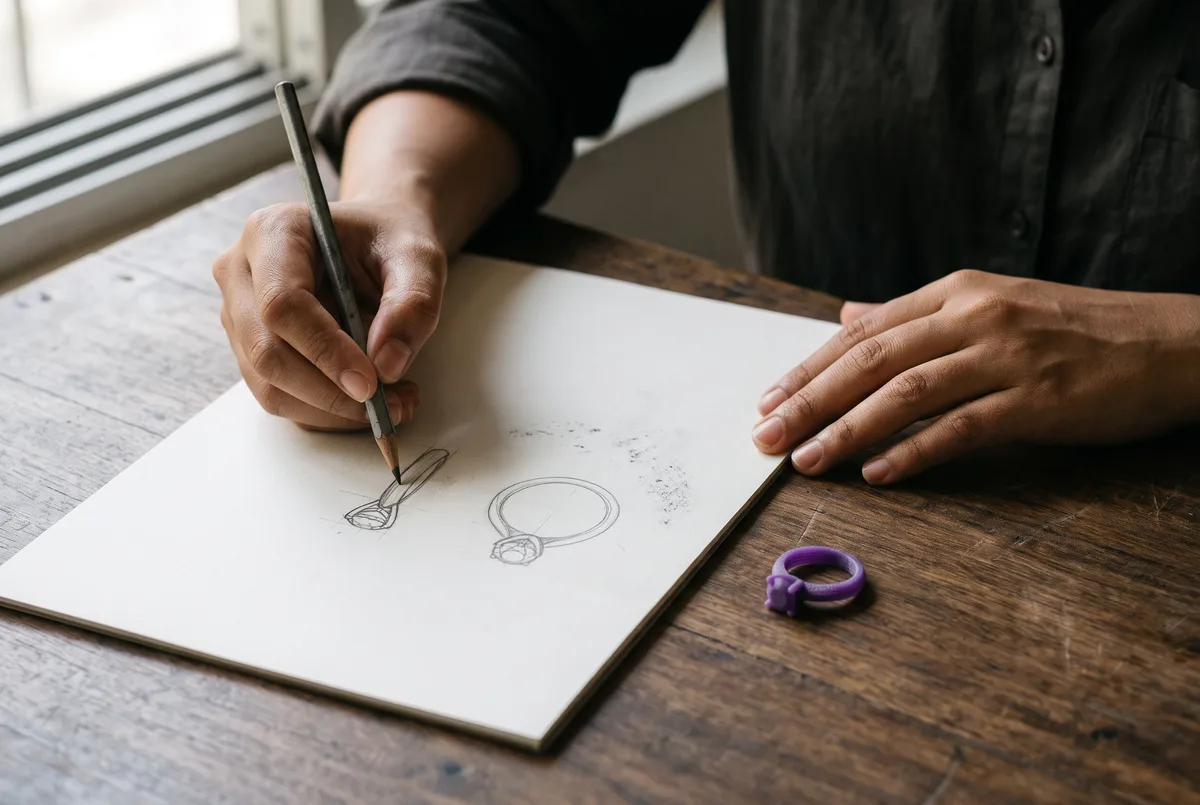
Each design passes through five stages: brief and sketch, CAD model, resin prototype, metal sample, then production. CAD is usually the first real cost. In one US bench jeweller's 2022 breakdown for MJSA, CAD time billed at $60, later $65, an hour, and a pendant took just under four hours: about $225.
Brief and sketch
A tight brief saves CAD hours. Give the designer a sketch or reference images, the metal and karat, ring sizes or chain lengths, stone sizes and shapes, the setting style and a target metal weight. The weight target matters most, because it keeps the finished piece inside the price band you chose.
CAD model
CAD turns the sketch into a 3D model that fixes dimensions, stone seats and wall thickness. Treat the MJSA figure as one shop's illustration, not a market rate. A pavé band takes longer than a plain solitaire, and every revision adds time. Ask how many revision rounds a CAD quote includes, and what each extra round costs.
Resin prototype
The approved model is printed in resin so you can hold it, try it on and check proportions before any metal is cast. It's the cheapest point to catch a band that's too thin or a setting that sits too high. Castable resin can also go straight into casting, which shortens the step to a metal sample.
Metal sample
The sample is cast in the real metal and karat, then set and finished. Weigh it and compare against the CAD estimate. A sample 0.5 g heavier than planned means every production piece carries that extra gold, so 50 rings carry an extra 25 g (50 × 0.5). Check the stamping, finish and stone security, and photograph the sample for listings.
First production order
The approved sample becomes the reference for production. Confirm in writing the quantities per size and karat, the gold-rate basis, the stamping and the packaging. Timelines vary by manufacturer and order: at Siona, bridal designs can be made from a single piece and typical production runs 2–6 weeks. The production timeline guide walks through the 4–8 weeks a custom order typically takes from brief to dispatch.
How much does it cost to start a fine jewellery line?
There's no honest single figure, because the budget scales with designs, karat, stones and markets. The line items can be pinned down, though. CAD ran about $225 for a pendant in MJSA's one-shop example, and India's hallmarking fee is ₹75 per article as of September 2026, per the amended BIS regulations.
Budget item | What drives the cost | Sourced figure or next step |
|---|---|---|
CAD model, per design | Complexity, revision rounds | About $225 for a pendant in one 2022 MJSA example ($60–65/hour) |
Resin prototype | Size, number of reprints | Ask for a quote |
Metal sample | Gold weight, karat, gold price on the day, making charge | Gold content × day's rate (see below), plus a making quote |
Diamonds and stones | Natural or lab-grown, size, quality | Ask for a quote per stone specification |
Grading reports | Lab, carat weight, service | Ask the lab or manufacturer |
First production order | Piece count, metal weight, setting work | Ask for a quote |
Trademark stamping (US) | Stamp or laser set-up | Ask for a quote |
BIS hallmarking (India) | Number of articles | ₹75 per article, ₹200 minimum per consignment, taxes extra (BIS amendment, Sep 2026) |
US import duty | HTS code, country of origin | 5.5% base plus 10% Section 301 on Indian gold jewellery as of Oct 2026 (USTR) |
UAE import duty | CEPA origin | 0% on Indian jewellery since 1 May 2022 (Gulf News) |
Packaging | Box type, branding, quantity | Ask for a quote |
Trademark registration | Jurisdictions, classes | Ask a trademark attorney |
Two quick examples show how the sourced figures scale. A launch collection of eight ring designs at the MJSA illustration's $225 each comes to $1,800 in CAD alone (8 × $225), before revisions. Hallmarking 200 pieces for sale in India costs ₹15,000 (200 × ₹75), plus taxes.
Neither is a quote. Ask for every line item separately, so you can see which costs are one-off and which repeat with each order.
How do founders handle gold price swings?
Gold is the cost a founder controls least. The World Gold Council counted 53 record highs in 2025, and gold passed $5,000 an ounce for the first time in January 2026. By 23 October 2026, spot was $4,032, Fortune reported, about 19% below that $5,000 mark.
On the 14K ring above, with 2.34 g of fine gold, that swing is real money. At $4,032 an ounce, fine gold is about $129.63 a gram (4,032 ÷ 31.1035), so the metal is worth about $303. At $5,000 an ounce it was about $160.75 a gram, or $376. Across a 50-piece order, the gap is roughly $3,640 (50 × $72.83), before making charges or duty.
A few habits keep it manageable:
- Check quote validity. A quote built on today's gold rate is only good for a limited window. Ask how long, and what happens after it lapses.
- Fix the gold at order. Agree that the metal is priced at the benchmark rate on the day you confirm (the LBMA price in dollars, or the IBJA rate in India), with making charges quoted separately.
- Keep metal and labour apart. If the quote splits gold value from making charges, re-pricing after a gold move means changing one number.
- Design to a weight. A lighter design carries less gold, so it carries less gold-price risk too.
What compliance rules apply in the US, Canada, India and the UAE?
Each market adds its own rules. In the US, 15 U.S.C. §297 requires a trademark or name on any piece that carries a quality mark such as "14K", applied the same way, at least as large and as close to the quality mark as possible. India charges ₹75 per article for hallmarking as of September 2026, and the UAE has applied 0% duty to Indian jewellery since 1 May 2022 under CEPA.
United States
The §297 trademark rule applies to importers as well as makers, so your mark should be stamped with the karat before the pieces ship. The FTC's lab-grown wording rules, covered above, apply to every listing and tag. On top of the 5.5% base duty, Indian gold jewellery carries a 10% Section 301 tariff from 24 July 2026, explained in US import duty on jewellery from India.
Canada
Canadian duty rates and marking rules differ from US ones. Confirm the tariff classification, rate and any marking requirements with a Canadian customs broker before the first shipment, and date the answer, because rates change.
India
Gold jewellery sold in India carries a BIS hallmark: the BIS logo, a purity mark and a unique HUID code, applied at a hallmarking centre. The fee rose from ₹45 to ₹75 per article under the BIS (Hallmarking) Amendment Regulations 2026, notified on 14 September 2026, as reported by News on AIR. Check the current fee with your hallmarking centre before costing.
UAE
Under the India–UAE CEPA, duty on Indian jewellery fell from 5% to 0% from 1 May 2022, Gulf News reported. Your importer needs the right origin paperwork to claim the preference, so ask your manufacturer what they supply with each shipment.
What should you ask a manufacturer before the first order?
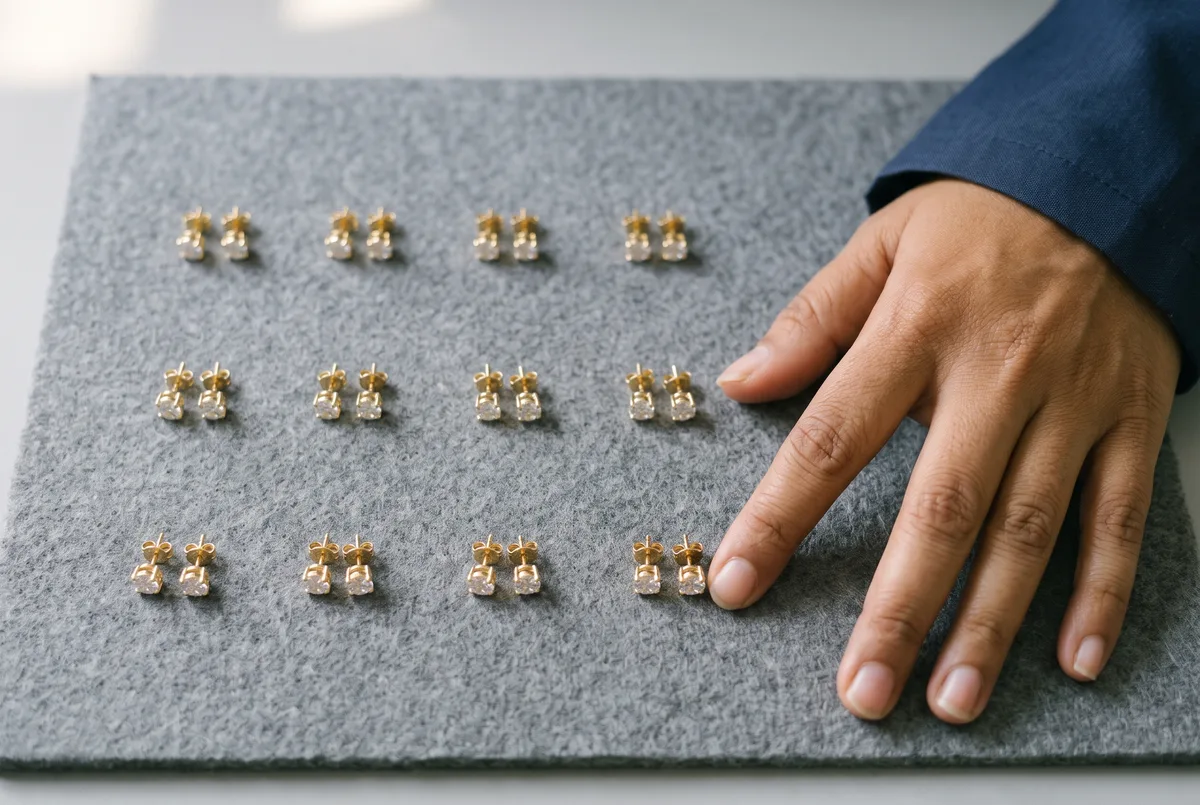
Get written answers on seven points before you sign, because each one changes cost or risk. On gold alone, a 14K ring with 2.34 g of fine gold lost about $73 of metal value between gold at $5,000 in January and $4,032 on 23 October 2026 (Fortune), so even timing belongs on the list.
- Minimum order per design. Ask whether each size or karat counts as a separate design for the minimum.
- Sample policy. What a sample costs, how many revision rounds are included, and whether the sample charge is credited against the first order.
- CAD ownership and confidentiality. Buyers often raise this first, and for good reason: the CAD file is the design. Ask who owns the file, whether the design will be offered to anyone else, and whether they'll sign an NDA before you share sketches.
- Turnaround. Separate timings for CAD, sample and production, and what happens if a date slips.
- Hallmarking and stamping. BIS hallmarking for pieces sold in India; your trademark plus the karat mark for the US.
- Gold fixing. When the gold price is fixed, against which benchmark, and how long a quote holds.
- Packaging. What's included, what branded packaging costs, and how pieces are packed for transit.
What to do next
Write a one-page brief before contacting anyone: markets, karat, stone type, a short list of hero designs, target metal weights and price bands. With 61% of engagement rings now lab-grown in The Knot's study, decide your stone policy in that brief too.
Then send the same brief to each manufacturer you're considering and compare the answers line by line, using the questions above. The private-label sourcing guide covers how to shortlist and vet manufacturers in India, including what to check on a factory visit.
Planning a range?
Send us your designs, metals and quantities, and we’ll reply with a quote and timeline within one business day.
Questions buyers ask
Under 15 U.S.C. §297, a piece stamped with a quality mark such as "14K" must also carry a trademark or name, and importers are covered too. The mark is stamped before shipping, so settle your brand mark early. Speak to a trademark attorney about registration; it affects your stamping dies and packaging.
Some manufacturers make bridal designs from a single piece; others set a minimum per design, especially for repeat lines. Ask whether each size and karat counts separately toward the minimum. For a first collection, single pieces let you photograph and test designs before committing to stock, at a higher cost per piece.
Supplying your own gold moves the timing of gold-price risk to you: you buy the metal, the manufacturer charges for labour. In India it also changes how the order is taxed, because it becomes job work, so check the GST position with your accountant. Buying metal through the manufacturer at a rate fixed on order is simpler.
CAD, casting, setting and polishing cost much the same whether the stone is lab-grown or natural. The difference sits in the stone price and the grading report. With lab-grown centre stones in 61% of engagement rings in The Knot's 2026 study, quote the same design both ways so the stone gap is visible.